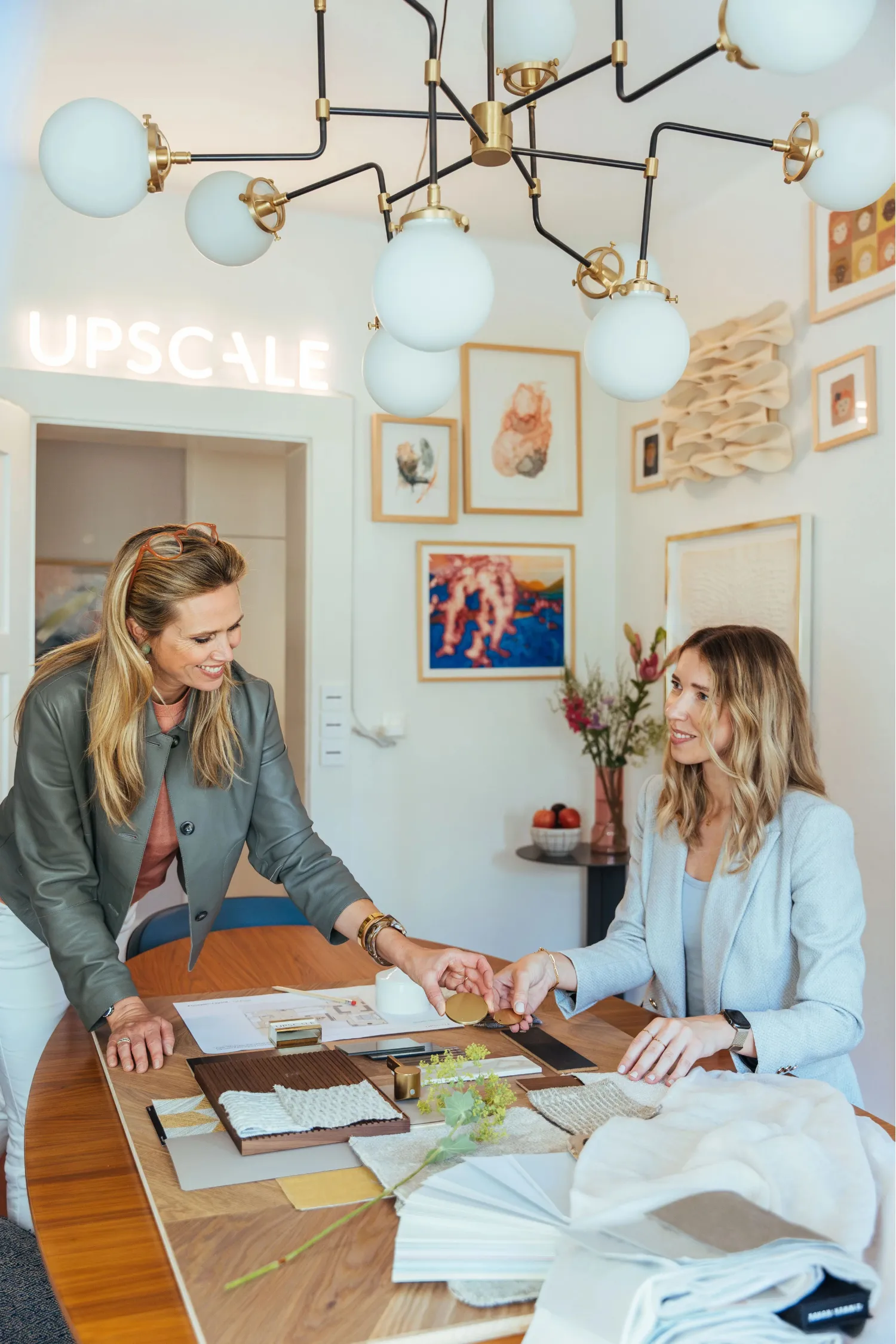
Sustainable interior architecture means designing a space so that it lasts, stays healthy to live in, adapts as your life changes and wastes as little as possible. In Zürich, where homes and offices are refitted often, the greatest gain comes early: a clear concept, durable materials and a plan for reuse, before anything is ordered. At Upscale Interiors we combine architecture and interior design expertise in one team, so these decisions are made together and not patched in later.
Upscale Interiors
Create a Lasting, Considered Interior
Explore Upscale Interiors’ bespoke interior design and architecture for residential and commercial spaces across Switzerland and Europe.
TL;DR
- Sustainable interiors rest on five ideas from Swiss research: longevity, sufficiency, flexibility, awareness from day one, and quality.
- Interiors are renewed far more often than building shells, so choosing pieces and finishes that last has an outsized effect.
- Ask for facts on materials: warranty, spare-parts availability, emissions, certified wood and recycled content.
- Reusing what you already own or what is still in good condition is the most resource-friendly move you can make.
- Settling your goals in the concept phase is cheaper and easier than correcting them on site.
What sustainable interior architecture really means
Many people hear "sustainable" and picture a pile of eco labels. Swiss research takes a wider view. The Competence Centre for Interior Architecture at the Lucerne University of Applied Sciences and Arts (HSLU) points out that interiors have short renewal cycles, which means enormous savings potential. A building's structure may stand for decades, while kitchens, floors, lighting and furniture are replaced again and again.
The same article describes sustainable design as more than proving energy efficiency. It asks for an understanding of environmental protection, quality of life and cultural responsibility together. A related HSLU publication goes one step further and argues that a high-quality interior is sustainable in itself: good room proportions, a thoughtful interplay of daylight and artificial light, honest materials and a link to the outdoors create a place people want to keep, and longevity and robustness are the key words.
That's good news if you're a homeowner or business owner in Zürich. You don't need to give up beauty or comfort. A well-designed room that you still love in fifteen years is, quite simply, the most sustainable room.
Five principles that guide a sustainable interior
The HSLU team behind the Immobilia article (December 2024) organises sustainable interior architecture into five categories. Here's what each one means when you're planning your own space.
- Longevity. Choose high-quality materials, or reuse existing components. A solid oak floor that can be sanded several times beats a cheaper floor replaced in a decade.
- Sufficiency. Use space compactly: "less is more". In a Zürich apartment with a premium price per square metre, a layout that makes every room work hard often beats adding area.
- Flexibility. Plan rooms that can change use, such as a guest room that becomes a study, or an office floor that can be rearranged without demolition.
- Awareness. Bring sustainability into the earliest concept phase, when it costs nothing to decide.
- Quality. Combine aesthetics with the quality of time spent in the room, including comfort and well-being.
Notice that none of these is a product. They are decisions about how a space is planned, which is why they belong with the person drawing the plans and choosing the materials.
Longevity is also a style choice
Timeless design is a sustainability tool. A room built around calm colours, good proportions and honest materials doesn't date, so it doesn't need to be redone when a trend passes. If you like that direction, our guide to quiet luxury interiors in Zürich shows how restraint and quality come together at home.
Light matters here too. Fixtures that are well made and suit the architecture stay in use for years. If you want inspiration for warm, layered lighting, these Scandinavian lighting ideas are a good starting point for thinking about a bright, welcoming home.
Start with what already exists
The cleanest material is the one that's already made. The Immobilia article notes that fit-out materials in Swiss renovation projects are often still within their service life but end up discarded, and HSLU research is developing strategies for reuse. Reuse is one possible design approach when it is planned in from the start, rather than improvised.
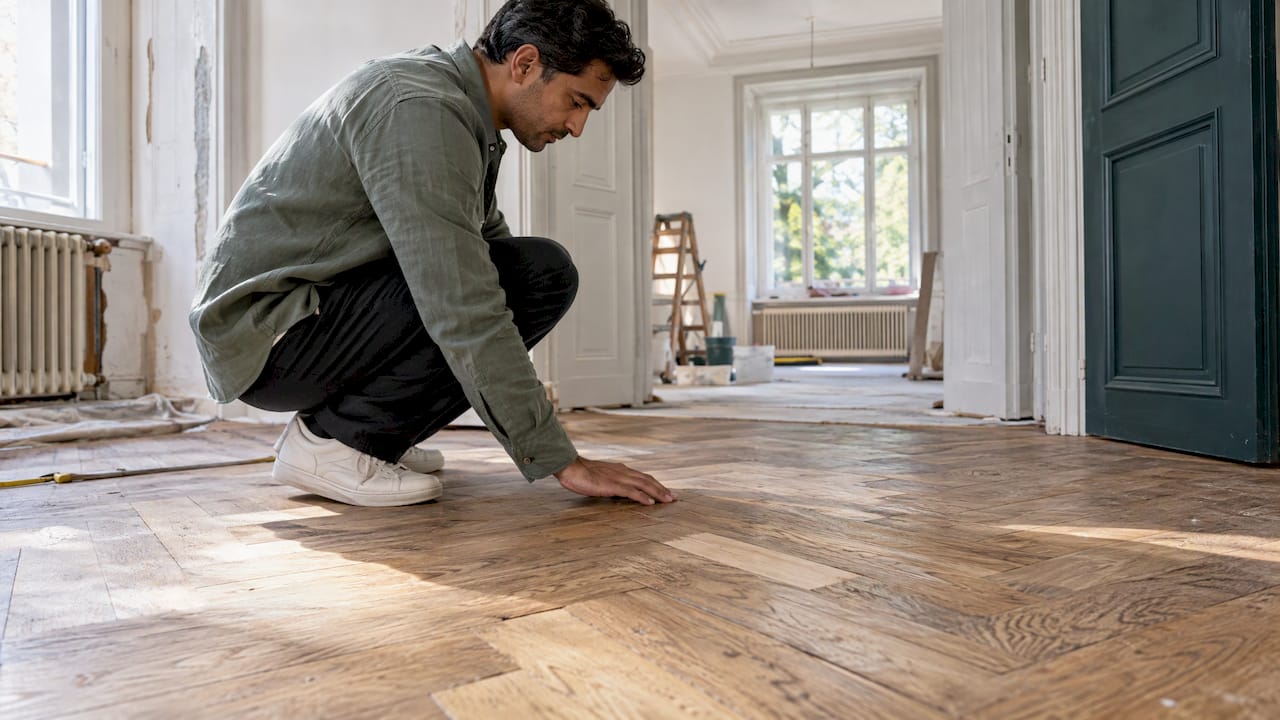
The British Institute of Interior Design says much the same: the most sustainable materials are those that already exist, and it recommends salvaging reclaimed wood, bricks and metal fixtures and retrofitting insulation, efficient HVAC and smart lighting. Its specifying guide adds that reusing existing materials or parts where possible is the most energy-efficient form of recycling, because it needs no repair or remanufacture.
In practice, for a Zürich home this might look like:
- keeping a beautiful parquet floor and restoring it instead of replacing it;
- re-using solid-wood doors or built-in joinery, refinished to suit a new palette;
- keeping the best furniture pieces you own and building the new scheme around them;
- giving pieces you no longer need a second life, rather than a skip.
A designer who sees the whole room can tell you which existing elements deserve to stay. Seeing the result in a 3D visualisation before anything is removed makes those decisions much easier.
Choosing materials you can trust
This is where most people feel lost. The good news is that Swiss authorities have already published practical criteria. The Canton of Zürich's procurement guidelines for furniture and interior fit-out are written for the canton's own purchasing, but they make a sound checklist for anyone who wants durable choices. They look at warranty and spare-parts periods, second-hand and recycled content, Cradle to Cradle certification, verified wood sourcing, solvent-free wood treatments, PVC-free plastics, OEKO-TEX Made in Green textiles and documented CO₂ footprints.
The same guidelines recommend at least a 10-year warranty against material and manufacturing defects and spare parts available for at least 15 years. They also suggest tiers for second-hand content (1 to 10% basic, 11 to 40% good practice, above 40% exemplary) and for recycled material content.
The Minergie-ECO standard points in the same direction. It names wood from sustainably managed forests, recycled concrete and emission-free materials as examples of ecological choices, excludes biocides, wood preservatives and solvents indoors, and includes room-air measurements and site checks during realisation.
Geneva's canton has published a similar guide with three goals: protect the environment, ensure good indoor air quality, and choose durable construction that facilitates reuse and simplifies renovation and deconstruction. It's written in French, but the logic travels well to any Swiss project.
Furniture that stays with you
If you love design furniture, longevity is already on your side. Pieces by established Italian and Scandinavian makers are built to be lived with for years, and the Zürich criteria above (warranty, spare parts, repairability) are the right questions to ask about any piece. Through our network of high-end furniture brands we source and deliver furniture, and our designers help you match each piece to the room it's meant for.
Healthy air, light and comfort
Sustainability isn't only about what leaves the planet. It's about how you feel at home. The Federal Office of Public Health's leaflet on healthy indoor climate says that new builds and window replacements need sufficient fresh air, possibly through ventilation systems, that newly installed materials should be as low-emission as possible, and that easy-to-clean surfaces and well-maintained ventilation reduce germ and dust formation.
Translated into design decisions:
- choose low-emission paints, adhesives and floor finishes;
- plan ventilation and window use together with furniture layout;
- pick surfaces that are easy to keep clean;
- use daylight generously and layer artificial light so you can set the mood for each moment.
Natural light and well-chosen lighting are also part of what HSLU calls the atmosphere of a room, so they pay twice: comfort now and a space that stays desirable.
Less waste, smarter planning
A systematic review of sustainability in interior design, published in July 2024, finds that effective waste management means reducing, reusing and recycling. It also points to modular and prefabricated components to cut on-site waste, recycled-content materials, training teams on waste segregation, and efficient lighting, HVAC and smart monitoring for energy.
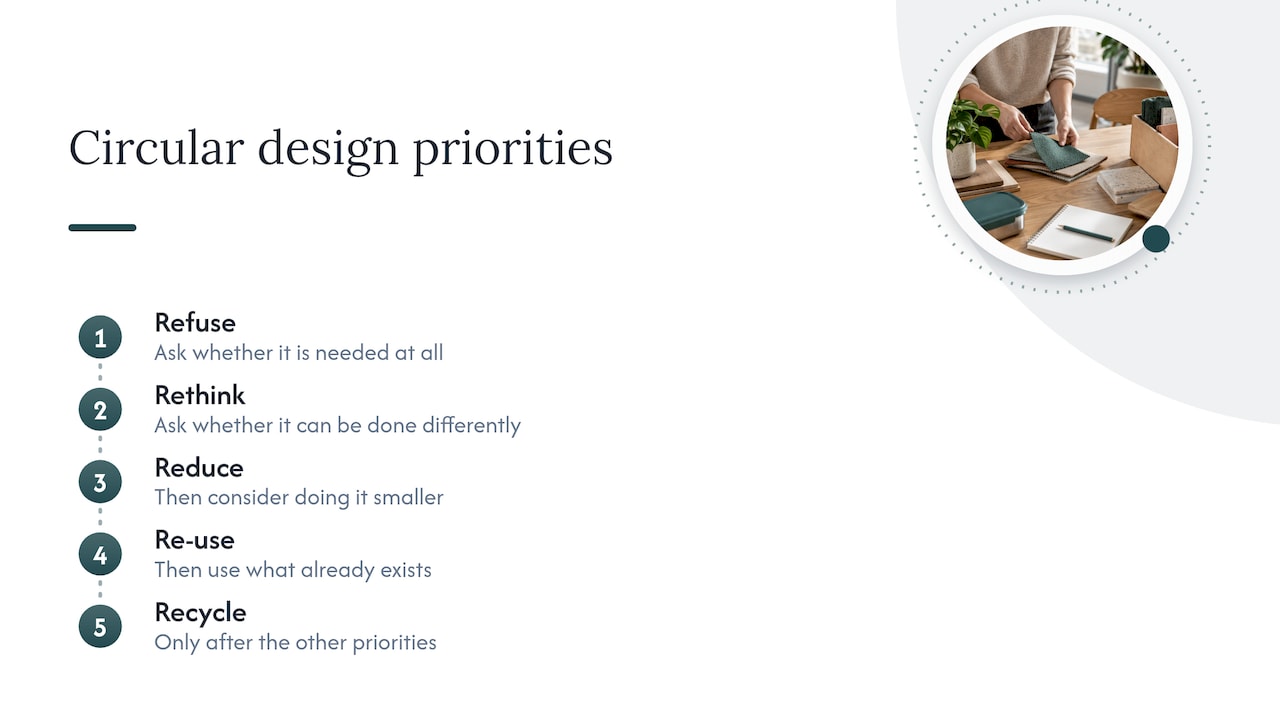
The Swiss federal energy office's guide for planners on circular building uses a priority order that works just as well for interiors: refuse, rethink, reduce, re-use, and only then recycle. Ask first whether something is needed at all, then whether it can be done differently, then smaller, then with what exists.
The BIID guide adds a practical point: consider whole-life costs, including maintenance, and design multi-use spaces with reusable components. A cheaper surface that needs replacing twice costs more than a better one bought once.
Homes, offices, developments and holiday homes
The principles are the same, but the emphasis shifts with who you are.
- Homeowners and expats. Start with longevity and a layout that fits how you actually live. If you're arriving in Zürich and building your interior concept from scratch, an early plan avoids buying twice.
- Business owners. Offices change faster than homes. Flexible layouts, modular furniture and good air and light support both staff well-being and a lower renewal rate. See our office design and commercial services.
- Developers. Early sustainability goals in the concept phase help a project keep its direction through many hands. The Swiss railways' construction policy, for instance, requires sustainability to be considered in every variant decision, qualitatively or through life cycle assessment, and favours environmentally friendly materials early, such as wood instead of concrete.
- Holiday homes. A second home is used in bursts, so robust materials and easy care matter even more. We design these too, on our holiday home design page.
How a sustainable interior project runs
Here's a simple route from idea to finished room, with what we do at each stage.
- Set your goals. Decide what matters: lasting quality, health, reuse, a certain label. Write it down before choosing anything. Our consultation is the place to do this together.
- Look at what you have. List furniture, floors, joinery and fittings that can stay. This is the cheapest and greenest step.
- Plan the space. Space planning and technical drawings fix the layout so rooms can adapt later. We prepare these as part of our services.
- See it before you build it. Our 3D visualisations let you judge proportions, light and materials without committing to them.
- Select materials and furniture. Use the criteria in the table above. We handle material selection and furniture sourcing across our network of brands.
- Deliver and install. Coordinated delivery and installation avoid damaged goods and wasted trips. We take care of both.
- Manage the project. With integrated project management, one team keeps the plan, the trades and the schedule aligned. Over 480 completed projects have taught us how much calm that brings.
Our perspective
We believe the most sustainable room is the one you never want to redo. That sounds simple, but it takes architectural thinking: how light moves through the space, how rooms can change with your family or your team, which materials will age beautifully rather than just survive.
Because we work in both architecture and interior design, we can talk about walls, layouts and finishes in the same conversation. That's where sustainability gets practical. A well-planned floor plan saves more resources than any single product label.
Every client in Zürich arrives with a different home and a different story, and our job is to bring the dots together: your existing pieces, new design furniture, the right materials and a plan you can trust from the first sketch to the final delivery. That's what makes a space feel just wow, and keeps feeling that way.
Giorgia D'Amico
Start your project with us
If you'd like to begin with a conversation, our consultation costs CHF 490. For one room, the Single Area Package is CHF 970. For a whole home, the Full Home Package is CHF 3,390. Larger or more complex projects, including offices and developments, are quoted individually. You can see all options on our interior design packages page, or request an individual offer for a bespoke project.
FAQ
Is sustainable interior design more expensive?
Not necessarily. Planning for longevity and whole-life costs, including maintenance, often means fewer replacements over time, as the BIID specifying guide suggests. Reusing existing pieces can also reduce what you need to buy. The right budget depends on your project, which we can talk through in a consultation.
Which certifications should I look for?
For materials, Swiss and European guidance points to Cradle to Cradle, OEKO-TEX Made in Green for textiles, verified wood sourcing and low-emission products. For whole buildings, Minergie-ECO covers health and ecological building. Your designer can tell you which are relevant to your rooms.
Can I keep my existing furniture?
Yes, and it's often the best starting point. Good furniture can be restored, reupholstered or simply placed in a new scheme. We plan around what you love and add new pieces where they make the room better.
Does sustainable design also apply to offices?
Absolutely. Offices are refitted frequently, so flexible layouts, modular elements, durable materials and good indoor air and light matter a great deal. The principles of longevity, flexibility and quality apply in just the same way.
When should I think about sustainability in my project?
As early as you can. Swiss research stresses bringing awareness into the concept phase, when layouts and materials are still open. Starting there costs nothing extra and shapes every later decision.
Sources
- Immobilia, December 2024, p. 41: sustainability in interior architecture (HSLU)
- HSLU mag-iia No. 3/2024
- BIID: What is sustainability?
- BIID Sustainable Specifying Guide
- Canton of Zürich: sustainable procurement of furniture and interior fit-out
- Minergie-ECO
- Canton of Geneva: reference for choosing healthy materials
- Federal Office of Public Health: healthy indoor climate
- MDPI: Exploring Sustainability in Interior Design
- Federal Office of Energy: circular building guide for planners
- SBB: sustainable construction projects
- Scandinavian lighting ideas
Recommended
- Practice Interior Design in Zürich
- Restaurant Interior Design in Zürich
- Gastronomy Interior Design Trends in Zürich for 2026