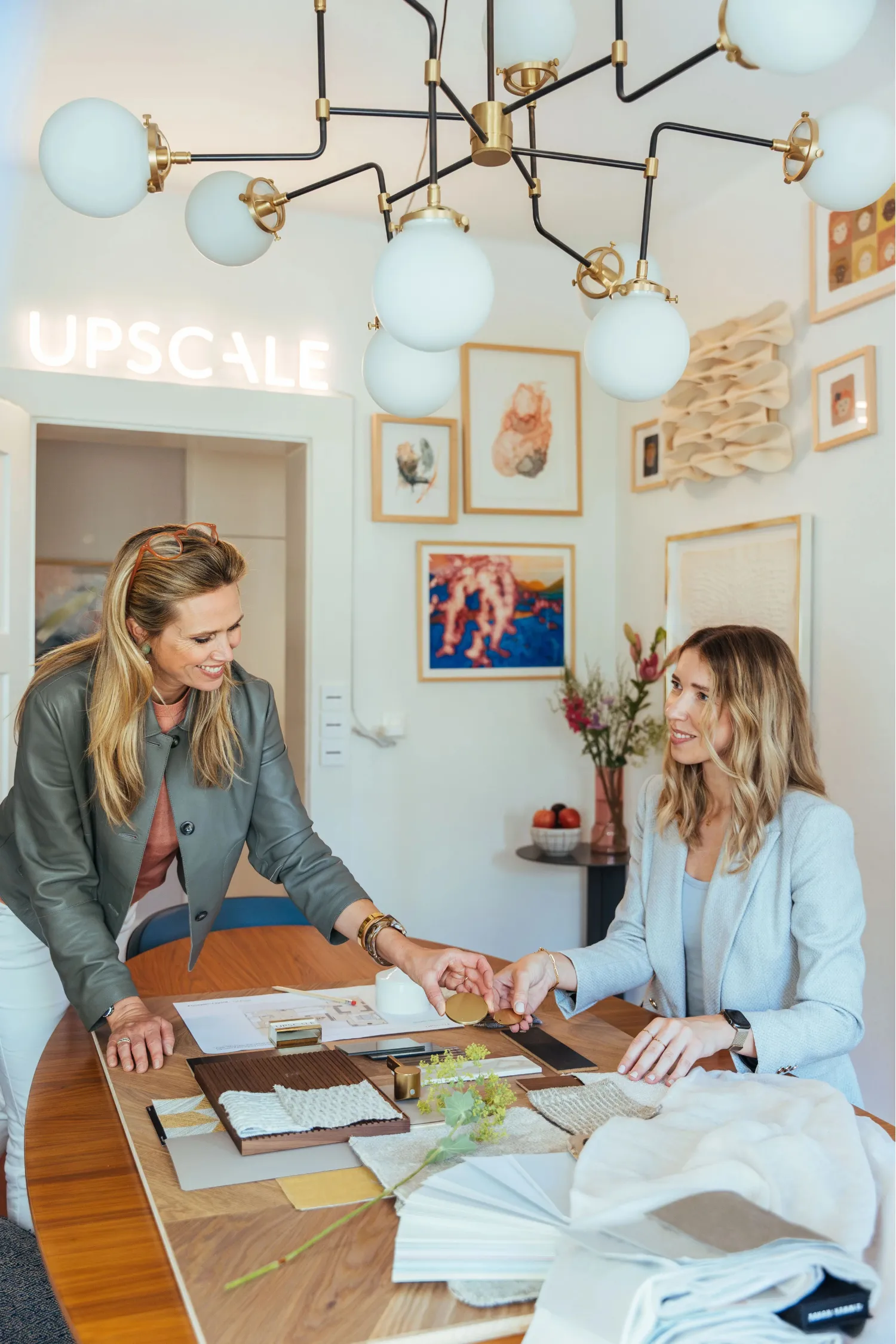
Quiet luxury at home means a calm, edited interior where quality does the talking: fine materials, muted colours, timeless shapes and no visible logos. You get there by choosing fewer, better things and letting texture, proportion and light carry the room. If you live in or around Zürich, you already have a head start: the lake light, the architecture and a strong culture of craftsmanship all suit this style.
Below, we walk you through what the look really is, which colours and materials work, how to plan a layout, and how to keep a quiet room warm rather than cold. We've also added a few Zürich-specific thoughts and a simple order of work.
Upscale Interiors
Create a Quietly Refined Zürich Home
Upscale Interiors creates bespoke residential spaces, with services including space planning, material selection, furniture sourcing and project management.
TL;DR
- Quiet luxury is about material quality, timeless proportions and a restrained palette, not about expensive-looking show pieces.
- Build the room in layers: natural surfaces first (lime plaster, stone, oiled wood), then furniture, then lighting and textiles.
- Symmetry, discreet storage and soft ambient lighting do most of the calming work.
- Tactile fabrics such as linen, boucle and jute stop a neutral scheme from feeling sterile.
- Start with one room, and buy pieces you can repair, re-cover and keep for decades.
What quiet luxury means in an interior
The style is a reaction to maximalism. BBC Culture describes it as a move away from visual cacophony towards sustainability and well-made pieces that last. The same article quotes designer Wim Pauwels, who sums it up as a non-ostentatious luxury built on exquisite materials and fabrics, muted colours, timeless designs and a pared-back chic that sits far from fast trends.
One useful way to think about it comes from a design studio that frames the style around three principles: absolute material quality, timeless proportions and chromatic sobriety. Texture and craftsmanship replace obvious ornament. If you remember only one thing, make it that: the richness is in the surface, not in the decoration.

There's also an emotional side. Designer Anita Yokota argues in Sunset Magazine that real luxury is how a space supports your nervous system, leaving you grounded and restored rather than impressed. We think that's the best test for any decision you make: does this make the room feel calmer to come home to?
Start with a palette that stays quiet
Quiet luxury is not simply "everything beige". It's a tight palette with depth, where tones sit close together and the variety comes from texture. A good rule is three to four colours at most: one light base, one mid-tone, one deeper accent and one metal or wood.
A lovely Swiss reference is the Chez Fritz restaurant in Zürich. Interior designer Ina Rinderknecht took her palette from the lake: muted greens, mineral shades and delicate natural tones, set against light limestone and an emerald-green quartzite, with warm woods, patterned Dedar fabrics and bronze accents. You don't need a restaurant budget to borrow the idea. You can translate it into a home with:
- A soft, chalky wall colour in a warm white or pale stone shade.
- One mineral green or grey-green for a built-in, a door or a single upholstered piece.
- Warm timber in one consistent tone throughout.
- A single metal, such as bronze or brushed brass, repeated in small doses.
Tip: look at your palette in the morning, at midday and in the evening. Zürich light changes a lot between a bright lakeside summer and a grey November, and a colour that looks serene in July can turn flat in winter. Warm undertones usually hold up best.
Choose materials you can see and feel
Materials are the heart of this style. A Swiss interiors studio lists the natural palette as natural plaster, travertine, limestone, sandstone and other stone, plus wood in simple forms, finished with natural oils so the grain stays visible. The same source points to lime plaster and oiled wood as the preferred finishes, and notes that carefully executed junctions between plaster and painted wood are part of the quality.

That last point is easy to overlook, and it's where a quiet luxury room separates itself from a lookalike. Shadow gaps, flush skirting, concealed hinges and clean edges are what you feel without noticing.
Where to spend and where to save
You can't put stone on every surface, so decide where your hands and eyes meet the room most.
A useful principle from the mountains: in a Verbier residence by designer Marianne Tiegen, the team used mineral limestone paint, weathered boards from dismantled alpine barns, reclaimed wood, linen, stone and antiques, all chosen to age gracefully. Materials that look better with use are the opposite of a trend, and that's the whole point.
Plan the layout before you buy anything
A calm room is planned, not decorated into calm. BBC Culture notes that symmetry and the avoidance of diagonal lines are key ingredients, because they quiet the senses. In practice that means:
- Pair things: two matching lamps, two identical armchairs, a centred sofa on a clear axis.
- Align furniture with the walls and architecture rather than angling it.
- Leave generous empty floor and wall space. Empty space is part of the design.
- Keep sightlines clear, so the eye travels to one focal point such as a window, a fireplace or a single artwork.
One of the easiest wins is hiding the clutter. Homewell lists simple organic forms, discreet storage and soft ambient lighting among the codes of quiet luxury. Handleless fronts, full-height wardrobes and a proper entrance cupboard do more for the feeling of calm than any piece of decor.
This is also the stage where a designer saves the most money. Space planning and technical drawings catch problems (a door that clashes, a socket in the wrong place, a sofa that's 10 cm too long) before they get built into the home.
Furniture: fewer pieces, better made
Curved, soft-edged forms are common in this style, but the real filter is longevity. When you're comparing pieces, Swiss furniture guidance suggests you check joints and stability, verify materials and finishes, and ask about spare parts and replacement fabrics, and consider modularity, low emissions and lifecycle cost.
The Swiss public-sector guidance on sustainable furnishing goes in the same direction. It prioritises long use, repairability and modularity and recommends checking for suitable used furniture before buying new. For a quiet luxury home, that can mean a vintage dining table paired with new upholstered chairs, which gives the room a sense of history rather than a showroom finish.
A short checklist before you commit to a major piece:
- Does the proportion suit the room, not just the photo?
- Is the frame solid and the joinery visible and clean?
- Can the fabric be replaced or re-covered?
- Will you still like the shape in fifteen years?
- Is the finish natural enough to repair rather than replace?
If you like Italian and Scandinavian design houses, this is where a designer with access to a wide furniture network helps. You see pieces in proportion to your actual floor plan before you order.
Lighting that glows rather than glares
Light is the cheapest way to make a room feel expensive, and the easiest to get wrong. Aim for layers: soft ambient light for the whole room, focused light where you read or cook, and one or two sculptural lamps as quiet accents.
- Use warm light bulbs consistently across the room, so tones don't compete.
- Put everything on dimmers.
- Wash walls with light instead of lighting the middle of the ceiling.
- Choose lamps with simple, sculptural shapes in ceramic, stone or paper.
A ceiling full of spotlights is the most common giveaway of an unconsidered scheme. A lighting plan drawn at the start, when cables are still easy to move, costs very little compared with changing it later.
Keep it warm: texture is the secret
The biggest fear with a neutral scheme is that it ends up cold or impersonal. The answer is layering. Warmth comes from chunky boucle throws, linen curtains that pool on the floor and jute rugs, which stop a neutral palette from feeling sterile.
A few ways to do it room by room:
- Living room: a deep, low sofa in wool or linen, a stone or timber coffee table, and one big rug that anchors the seating. If you want to understand how a good rug changes a space, there's a helpful read on choosing rugs for a compact studio.
- Bedroom: layered bedding in washed linen, curtains to the floor and low, warm bedside light. Our guide to designing a master bedroom suite in Zürich goes deeper on this.
- Kitchen and dining: oiled wood, a stone worktop and a handful of well-chosen ceramics, with everything else behind doors.
- Hallway: a bench, a mirror and a good coat cupboard. First impressions matter.
Then add the personal layer: books, a few framed works, a piece of family pottery. Quiet luxury is not anonymous. It simply edits the personal things so each one can be seen.
Working with your existing architecture and heritage pieces
Many Zürich homes come with character you shouldn't fight: altbau ceilings, parquet, a lake view, a tiled stove. The quiet approach is to let one strong feature lead and keep everything else supportive. If you have a beautiful original floor, choose a calm wall colour and simple furniture so the floor becomes the star.

Inherited or antique pieces are a gift in this style, because they bring age and meaning. Give each one space, restore rather than replace where you can, and mix it with clean-lined contemporary furniture. A single antique chest against a plain, plastered wall looks far richer than five scattered "decorative" pieces.
If your home is modern and a bit bland, you can add depth with architectural details: deeper window reveals, built-in joinery, or a plastered feature wall. That's often what a designer with an architecture background does best.
A Zürich perspective: lake light, mountains and everyday use
Zürich homes tend to be compact, bright and well built, with strong views of water and sky. That favours a restrained scheme, because nature already supplies the colour. Think mineral greens and soft greys that echo the lake, and warm woods that echo the surrounding hills. If you want to see how we think about the city's homes, our Zürich interior design page is the place to start.
For second homes, the same principles carry over to the mountains, with more reclaimed timber and more texture. Our holiday home design service covers exactly that.
Our perspective
Quiet luxury is the style we're asked about most often by clients who already own beautiful things and still feel their home isn't finished. Almost always, the missing ingredient is not another object. It's a plan.
Because we work as both interior architects and interior designers, we look at the room as a whole: the proportions, the junctions between materials, the lighting circuits, the storage, and only then the furniture. That's why our projects, more than 480 completed so far, begin with space planning, material selection and technical drawings, and only afterwards move to sourcing furniture from our network of over 185 brands.
Our advice is simple. Choose fewer pieces, choose them well, and give every surface a reason to be there. Use 3D visualisations to test your palette and layout before anything is ordered, so you can see how the lime plaster, the oak and the linen sit together. You'll make calmer decisions, and you'll avoid the expensive second-guessing that happens once the sofa is already in the room.
And don't worry if you're not sure where to start. A style direction, a floor plan and an honest conversation are enough to begin.
Giorgia D'Amico
Start with the right level of help
You can begin small. Our online packages are priced as published: a consultation is CHF 490, a Single Area Package is CHF 970 and a Full Home Package is CHF 3,390. If you'd like a quiet luxury scheme for your whole home, take a look at the Full Home Online Package. For larger or more complex projects, an individual offer is tailored to your property, and you can start a project with us at any time.
A simple order of work
- Define the feeling. Write down three words for how the room should feel (for example: calm, warm, generous).
- Edit what you own. Keep what you love and what's well made. Sell or donate the rest.
- Fix the architecture. Walls, floors, joinery and lighting come before furniture.
- Set the palette and materials. Sample them in your own light for at least a week.
- Choose key furniture. Start with the sofa or bed, then tables and storage.
- Layer textiles and lighting. Rugs, curtains, throws and lamps finish the room.
- Add the personal. A few objects, placed with care.
FAQ
Is quiet luxury the same as minimalism?
Not quite. Minimalism removes; quiet luxury removes and then enriches. You keep a restrained palette and few objects, but you add depth through materials, craftsmanship and tactile fabrics, so the room feels warm and considered rather than empty.
Can I create a quiet luxury look on a modest budget?
Yes, if you spend where you touch and see the room most. Put money into one good sofa, decent lighting and a natural wall finish, and keep the rest simple. Buying second-hand or antique pieces also fits the style well, and Swiss sustainable-furnishing guidance itself recommends checking for used furniture first.
Which colours work best?
Soft, warm neutrals with a mineral or muted green accent are a safe base, with warm wood and a touch of bronze or brass. Keep to three or four colours and vary texture instead of adding more colour.
How do I stop a neutral home feeling cold?
Layer textures: linen curtains, a boucle throw, a jute or wool rug, oiled wood and warm, dimmed lighting. Add a few personal objects so the room feels like yours.
Do I need a designer for this style?
You can do much of it yourself, but the style depends on proportion, detailing and lighting that are hard to judge from photos. A designer helps you plan the layout, test materials in 3D and avoid costly mistakes, and a single consultation can already clarify your direction.
Sources
- Inside the homes that 'whisper rather than scream luxury' (BBC Culture)
- The 5 Simple Rules to Getting Quiet Luxury Right (Sunset)
- Quiet Luxury Interiors: the art of silence and materiality (Hart Design Selection)
- Riviera-Gefühl am Zürichsee (Meter Magazin)
- Quiet Luxury in Interior Design (A&A Deco)
- 2025 décor trend: quiet luxury at home (Homewell)
- Quiet Luxury Interiors (Elevate)
- Mobilier suisse : repères d'histoire, marques et critères
- Merkblatt Möbel (Wissensplattform nachhaltige öffentliche Beschaffung)
- Rediscovering luxury: circular design in Verbier (ADF Web Magazine)
Recommended