Investors manage portfolio risk by doing four things in order. They define how much loss they can afford and tolerate, spread their money across asset classes, regions and sectors, review and rebalance on a fixed schedule, and keep every large holding in good working order. If you live or invest around Stansstad on Lake Lucerne, that last point matters more than most guides admit, because for many local investors the biggest single position is a home or rental property rather than a share portfolio.
This guide walks through each step with Swiss sources, and then looks at the property side, where interior planning, maintenance and presentation quietly protect (or erode) value.
Upscale Interiors
Plan Property Improvements With Care
Upscale Interiors helps property owners shape tailored spaces through interior design, space planning, material selection, and project management.
TL;DR
- Start with a risk profile that separates what you can afford to lose (risk capacity) from what you can stomach (risk appetite).
- Diversify across asset classes, regions, sectors and timing, and count your home or rental property as part of the picture.
- Set a rebalancing rule in advance, so that decisions are made calmly rather than in a market panic.
- Zero risk does not exist, and staying out of the market has a cost too: inflation.
- Property is a portfolio position that needs its own risk plan: maintenance, layout, and a sensible budget for upgrades.
Start with your risk profile, not with products
Before you pick a fund, a mandate or a flat to buy, you need to know your starting point. Nidwaldner Kantonalbank (NKB), the cantonal bank for Nidwalden, begins with your goals and your current situation, and uses a structured questionnaire to establish your risk tolerance before an investment strategy is defined. That order is the right one, whoever you invest with.
Two ideas sit inside a good risk profile, and they are easy to mix up:
- Risk capacity: the financial ability to absorb a loss. This depends on your income, your reserves, your debts, your age and when you will need the money.
- Risk appetite: your personal willingness to sit through volatility without selling at the worst moment.
A founder with a large cash buffer may have high capacity but low appetite. A young professional may be the reverse. The lower of the two should usually set your ceiling. If you have never written either down, do it this week: a single page with your capacity, your appetite and the date you will need the money is already a risk-management tool.
Your investment horizon does most of the work
NKB's advisers describe the investment horizon as one of the most important factors in managing risk. A long horizon lets you ride out market swings, whereas trying to time the market without one tends to produce emotional, reactive decisions. In practice, money you need within three years and money you will not touch for twenty should not sit in the same bucket, even if they sit in the same bank.
Diversify: more than owning many things
Diversification is the oldest and most reliable tool for lowering risk. Raiffeisen explains that broad diversification takes in different asset classes, regions and sectors, and also the timing of your investments. BEKB makes the same point plainly: you should not put everything on one card, for instance by holding the shares of a single company.
The reasoning is that gains and losses in a broadly spread portfolio tend to offset each other. Raiffeisen also reminds readers in its piece on return and risk appetite that risk never disappears entirely: without risk there is no return.
Four dimensions to check
DimensionThe question to askA typical blind spotAsset classHow much is in shares, bonds, cash, property, alternatives?Holding mostly one class because it performed well recentlyRegionIs everything tied to Switzerland, or to one currency?Home bias: Swiss shares, Swiss property, Swiss pensionSectorDo your holdings all depend on the same industry?Employer shares plus a sector fund of the same industryTimingDid you invest everything on one date?A single large entry just before a downturn
If you hold a house or an investment flat around Lake Lucerne, you already have a large, concentrated, illiquid Swiss real estate position. That is not a problem in itself, but it means your financial portfolio should be built with that in mind, not as if the property did not exist.
Rebalance on a rule, not on a feeling
Over time winners grow and losers shrink, so a portfolio drifts away from the risk level you chose. Rebalancing means bringing it back. Professional mandates make this systematic. NKB's VERWALTEN Komfort offers active, individual asset management with monthly portfolio adjustments, and according to the research gathered for this article it corrects deviations beyond 5 percent. Its published entry point is a minimum investment of CHF 100,000, so check the current terms directly with the bank.
You do not need a mandate to copy the principle. Pick a rule such as: review twice a year, and rebalance whenever any asset class is more than five percentage points from its target. Write it down while markets are calm. Even the Swiss National Bank manages its investments through reference portfolios, guidelines and limits, which is the same discipline at a much larger scale: decide the limits first, then act within them.
Managed or self-directed?
A managed solution suits you if you lack time or prefer to hand over day-to-day decisions. Self-directed investing, for example through broad funds, suits you if you are willing to stick to your rule. Either way, ask for costs in writing, ask how risk is measured, and ask what happens to your portfolio in a sharp downturn. For legal, tax and investment decisions specific to your situation, speak to a licensed adviser at your bank or an independent asset manager and, for tax, to a Nidwalden tax specialist.
Why avoiding risk is not the same as managing it
It is tempting to keep everything in a savings account. AXA's experts caution that zero risk is an illusion, and that for many investors in Switzerland the greater danger is not investing at all, since inflation steadily erodes purchasing power. They describe investing as a balance between safety, profitability and availability of your money, and you cannot maximise all three at once.
Managing risk, then, means matching it to your own financial reality and goals. It does not mean eliminating it.
The part most guides skip: your property is a position
In and around Stansstad, many investors hold property: a family home, a lakeside flat, a rental unit, perhaps a holiday home. Property behaves differently from a share fund. You cannot sell a bathroom on a Tuesday afternoon. Costs are lumpy, and the value depends on condition, layout and how the place feels to the next buyer or tenant.
That means property risk is managed with a different toolkit:
- Condition risk: deferred maintenance becomes expensive repairs.
- Vacancy risk: a tired or awkward layout takes longer to let or sell.
- Concentration risk: too much of your wealth in one building, one village, one market.
- Liquidity risk: you may need cash when the property cannot be sold quickly.
Maintenance is risk management
Regular, planned maintenance is cheaper than emergency repair. A landlord-oriented guide on preventive maintenance for rentals lays out how a routine of inspections helps landlords avoid surprise costs. The details differ by country, so apply the idea, not the rules, to Swiss tenancy law. Keep a simple calendar for roofs, heating, windows, damp-prone rooms and kitchens, and set aside a yearly reserve in your budget so a repair never forces you to sell investments at a bad moment.
Layout and finish protect value
A well-planned interior is not decoration for its own sake. It affects how quickly a property lets, how it presents when you sell, and how much you spend on rework later. Poor space planning, cramped storage or mismatched materials are quiet value leaks. For owners who run companies from the same region, the logic extends to offices too: our article on the benefits of professional space planning explains how a planned layout supports how people actually work.

If you are weighing a larger renovation, it is also worth reading why owners elsewhere in Switzerland choose quality upgrades, as in our piece on why Winterthur homeowners choose high-end renovations. The context differs from Lake Lucerne, but the reasoning about durable materials and long-term value carries over.
A practical example: an owner with one big asset
Imagine an investor in Stansstad whose wealth is roughly this: a lakeside flat, a pension fund, and a modest securities account. This is an illustration, not a real client or a recommendation.
- Profile: the investor has strong capacity thanks to stable income, but low appetite, since the flat is most of their net worth. The ceiling for the securities account is therefore moderate.
- Diversify: because Swiss property is already large, the securities account leans towards global shares and bonds rather than adding more Swiss real estate funds.
- Rule: twice-yearly review, rebalance at a five-point drift.
- Property plan: a maintenance calendar, an annual reserve, and a planned refresh of the kitchen and bathroom before the next let or sale rather than after.
- Cash buffer: enough liquid savings to cover a major repair without selling investments.
None of this is exotic. It is simply the order of operations that stops one bad year, or one broken boiler, from becoming a crisis.
Our perspective: what we see when investors renovate
We are an interior design and interior architecture firm, not a bank, and we will not tell you how to allocate your securities. What we do see, across more than 480 completed projects, is how owners treat the property side of their wealth, and the pattern is consistent.
The owners who feel most relaxed about their property are the ones who planned before they spent. They decided on the purpose of each room, chose materials for durability rather than for a single season, and set a budget that included a reserve. Because we combine architecture and interior design with integrated project management, we can look at a space the way an investor looks at a position: what is it for, what will it cost to hold, and what will make it more resilient?
A few habits we would encourage:
- Plan the whole before the parts. Space planning first, finishes second. It is far cheaper to move a wall on a drawing than on site.
- Choose quality where wear is highest. Kitchens, bathrooms, flooring and storage reward good materials.
- Visualise before you commit. 3D visualisations let you catch costly mistakes while they are still free to fix.
- Keep it timeless. Rental and resale value tend to favour calm, well-made interiors over trends.
Property is also an emotional asset, and that is fine. A home that feels cosy, works well and looks wow in the evening light over the lake is doing its job, financially and personally.
— Giorgia D'Amico
How we can help you plan the property side
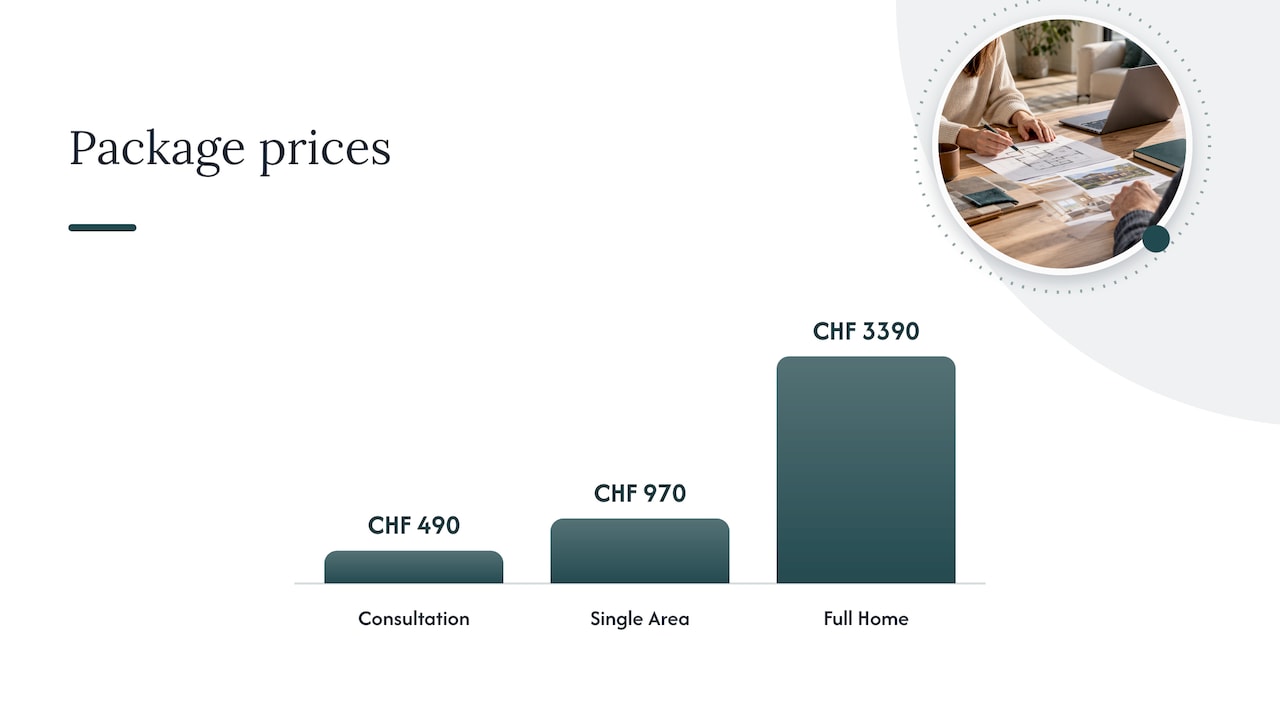
If you want a clear, fixed-cost way to start, we offer online packages with published prices: a Consultation at CHF 490, a Single Area Package at CHF 970 for one room or zone, and a Full Home Package at CHF 3390 for the whole property. For larger or more complex briefs, such as holiday homes or rental portfolios, we prepare an individual offer. Our holiday home design service and our commercial and real estate services cover owners who manage more than one property.
Not sure where to begin? Browse the interior design packages and book a consultation. We would love to hear what your property needs.
A simple yearly risk routine
Put it in your calendar and keep it short:
- January: update your risk profile. Has your income, family situation or horizon changed?
- Spring: review allocation against targets and rebalance if a class has drifted past your limit.
- Spring: inspect the property, from roof and facade to heating and wet rooms, and update the maintenance list.
- Autumn: second allocation review, and check your cash buffer against the largest likely repair.
- Year-end: decide which property upgrades to plan for next year, and budget them.
This routine takes a few hours a year, and it replaces a lot of anxious guessing.
FAQ
How do investors manage risk?
They start by defining how much loss they can afford and tolerate, then spread their money across asset classes, regions and sectors. They review the portfolio on a fixed schedule and rebalance when it drifts from the target. The aim is to match risk to your goals, not to remove it.
How can I reduce risk in an investment portfolio?
Broad diversification is the first lever, as Swiss banks such as Raiffeisen explain. The second is a long investment horizon, and the third is a written rebalancing rule. If property is a large part of your wealth, count it in your allocation too.
Is a managed mandate worth it for investors in Stansstad?
That depends on your time, your preferences and the amount you invest. Some mandates, such as NKB's VERWALTEN Komfort, publish a minimum of CHF 100,000 and offer monthly adjustments. Compare costs and how risk is measured, and speak to a licensed adviser before deciding.
Does home maintenance really belong in portfolio risk management?
Yes, if the property is a major part of your wealth. Deferred maintenance, vacancy and a lack of liquidity are all risks that a plan and a yearly reserve can reduce. A well-planned interior also supports letting and resale.
Sources
- NKB: Wie muss ich vorgehen, wenn ich mit Geldanlagen starten möchte?
- NKB: VERWALTEN Komfort
- Raiffeisen: Diversifikation
- Raiffeisen: Renditechancen und Risikobereitschaft
- BEKB: Diversifizierung, Risiken beim Geldanlegen verringern
- Swiss National Bank: Investment and risk control process
- AXA: Anlagetipps, Geld anlegen ohne Risiko?
- RentrIQ: Preventive maintenance for rentals
Recommended
- Seven Modern Upgrades to Bring Alpine Minimalism to St Gallen Homes
- Why St. Gallen Homeowners Are Investing in Bespoke Libraries
- Kilchberg Bespoke Joinery: Lighting, Cable Routing and Resale Value