Marble stays beautiful in a Zürich home when you do three things: clean it with a pH-neutral, acid-free product and as little water as possible, blot spills the moment they happen, and have the surface impregnated and re-checked on a schedule that suits the room. Everything else, from stain removal to polishing, follows from those habits. Below you'll find the routine room by room, a stain-by-stain first-aid list, and a clear line between what you can fix yourself and what needs a stone specialist.
Upscale Interiors
Plan Marble for Easier Care
Explore bespoke interior design and interior architecture for tailored spaces, including material selection and space planning.
TL;DR
- Clean marble with warm water and a pH-neutral, acid-free cleaner. Never use vinegar, lemon, descalers or scouring products.
- Blot spills straight away, don't wipe, then rinse and dry the surface.
- Impregnation makes marble more stain-resistant but doesn't stop acid etching. Check it every 1 to 4 years depending on the room.
- Light dull marks can often be buffed out at home. Deep etching, scratches and whole floors need a professional machine polish.
- Choosing the right finish and placement at the design stage makes daily care much easier.
Why marble needs its own cleaning routine
Marble is a carbonate stone, and that single fact explains almost every care rule. Acids dissolve a thin layer of the surface, leaving dull spots, while oil and grease soak into the absorbent stone and leave dark stains. Sand under shoes acts like sandpaper on a polished floor.
So marble reacts to two different problems:
- Staining: a liquid or fat has soaked into the pores. It sits inside the stone and can often be drawn out.
- Etching: an acid has eaten into the finish. The mark is a change in the surface itself, so no cleaner removes it and no sealer prevents it.
Knowing which one you're looking at decides what you do next. A dark ring under a glass of oil is a stain. A pale, matte ring where lemon juice or wine sat is an etch.
The everyday cleaning routine
For daily care, keep it gentle. Swiss stone-care guides agree that warm water and a pH-neutral or mildly alkaline household cleaner are enough, and that all-purpose cleaners are often acidic. The technical guidance for acid-sensitive stone such as marble is more precise: only products with a pH of 7 to 10 suit cleaning and care.
Step by step
- Remove dry dirt first. Dust or vacuum with a soft attachment. Grit is the most common cause of fine scratches on polished marble.
- Mix a mild solution. A few drops of liquid Marseille soap in a bucket of lukewarm water works well, as does a dedicated pH-neutral stone cleaner.
- Wring the cloth or mop until barely damp. Excess water is a key risk for marble, because standing water can penetrate even impregnated stone and leave marks.
- Dry the surface. Drying after wiping matters most on polished stone, where water spots show quickly.
- Do it regularly. Frequent light cleaning beats an occasional heavy scrub every time.
What to keep away from marble
The lists from Swiss stone specialists overlap almost completely. Keep these away from marble:
- Vinegar, citric acid, lemon and limescale removers
- Acidic bathroom and toilet cleaners
- Scouring cream, scouring powder and scratchy sponges
- Strong degreasers and oil-containing care products
- Solvent-containing products and highly alkaline products such as oven cleaners
The pH figures above and the full avoid-list come from the same technical guide. One more safety point for the bathroom: never combine bleach with an acid product, because the Federal Office of Public Health warns that this releases toxic gas. In case of poisoning, Tox Info Suisse is available around the clock on 145.
Can you clean marble with baking soda?
It's tempting, because baking soda is mild and already in the cupboard. Swiss care guidance, however, lists baking soda, washing soda and chlorine cleaners among the household remedies to use on natural stone only after professional assessment. A pH-neutral stone soap does the same job with no guesswork, so that's the safer habit.
Room by room in a Zürich home
The same stone behaves differently depending on where it sits.
Living room and hallway floors
Floors suffer from grit, so a mat at the entrance and regular dry cleaning do half the work. Swiss specialists suggest that crystallisation polish is done every one to two years in private homes, with a marble-specific wax between polishes (never the parquet kind). Those figures come from a Ticino source, so treat them as a guide rather than a Zürich price list. For impregnation, one Swiss care guide suggests checking living-area floors every two to four years and entrance or heavily used zones every one to two years.
Coffee tables, consoles and side tables
Coasters are your best friend. Wine, coffee, juice, cola and even a squeeze of lemon in a drink can leave an etched ring. Dry cleaning is usually enough for furniture, and small marks can be wiped with a damp cloth in gentle circular motions, then dried with a soft cloth.
Kitchen worktops
Kitchens combine oil, acid and heat. Use a chopping board, and never put hot pots and pans straight onto marble: heat shock can cause cracks and discolouration. Swiss guidance puts the impregnation check for a kitchen worktop at every one to two years. For grease, remove it quickly with a cotton cloth and hot soapy water so oil and fat can't permeate the stone.
Bathrooms
Bathrooms are where marble looks its most luxurious, and where water, soap and limescale test it daily. Wipe splashes immediately, dry surfaces after use, and use acid-free cleaners only. Drying is also the most effective prevention against limescale. For a shower, squeegeeing after each use also prevents soap scum building up. When soap scum is stubborn, choose a cleaner labelled as marble-safe rather than a general bathroom product. Many everyday sanitary cleaners contain natural acids, and some manufacturers state plainly that they are not suitable for limestone such as marble.
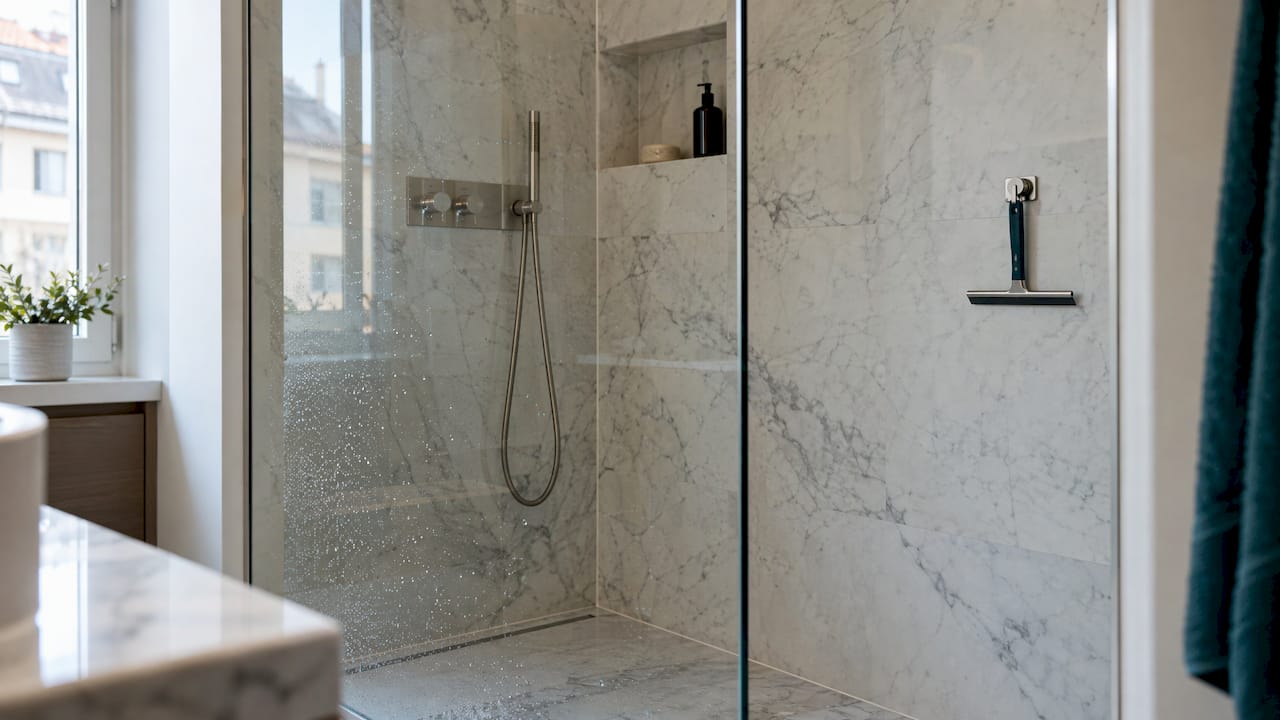
Light limescale deposits can be treated mechanically, for example with a glass-ceramic scraper or a white pad, never with a descaler.
Stains: first aid that works
Speed matters more than any product. The Natural Stone Institute advises blotting a spill with a paper towel immediately, not wiping, because wiping spreads it. Then flush with plain water and mild soap, rinse several times and dry thoroughly.
SpillWhat to doOil or greaseAbsorb with kitchen paper without rubbing, then clean with lukewarm water and a pH-neutral stone cleanerRed wineBlot at once and rinse with clear water. Avoid acidic stain removersCoffee or teaAbsorb, dilute with water, then clean with a pH-neutral productLimescaleTreat light deposits mechanically. Never use vinegar or a descalerStubborn organic stainSee the poultice method below
If a glass of red wine goes over, the same blot-don't-rub principle applies across surfaces, and this guide to removing red wine stains shows how fast action changes the result, even though marble needs a stone-safe cleaner rather than the carpet products it describes.
The poultice for deep stains
For a stain that has sunk in, a poultice draws it out. The Natural Stone Institute describes mixing a liquid cleaner with a white absorbent material to a paste about the consistency of peanut butter. Spread it 1/4 to 1/2 inch (roughly 6 to 12 mm) thick, extending an inch beyond the stain, and cover it with plastic. Leave it for 24 to 48 hours, remove it and rinse with distilled water. Difficult stains may need up to five rounds.
The same source suggests 12% hydrogen peroxide with a few drops of ammonia for organic stains such as coffee and fruit, and mineral spirits or acetone for oil-based stains. These are strong products, so ventilate the room, wear gloves, and don't mix them with other cleaners. On a valuable or light-coloured piece, a small hidden spot is the place to start. And when in doubt, a stone professional is the better call, because what suits granite can be disastrous for marble.
Impregnation: how it protects, and what it can't do
An impregnation (a penetrating, invisible treatment) makes marble water- and oil-repellent. It works on staining, not on acid. Swiss sources say this clearly: pore-fillers protect against water and oil but not against acids, and sealing does not prevent dull etch marks. Acid stays off-limits either way.
How often should you renew it? Recommendations vary with the product and the room, so follow the manufacturer's instructions. As a rough guide:
- Shower or wet area: annually
- Kitchen worktop and bathroom washbasin: every 1 to 2 years
- Living-area floors and interior window sills: every 2 to 4 years
- General guidance for acid-sensitive stone: renewal after about 3 to 5 years or as needed
The room-by-room intervals come from one Swiss care pass, which also suggests a simple water-drop test: if water beads, protection is intact, and if the stone darkens quickly, it's time to re-impregnate.
Marble also isn't the only thing in the house that benefits from a schedule. Keeping a simple preventative maintenance routine for the whole home makes it much easier to remember when the stone is due a check.
Dull patches: DIY polish or professional restoration?
A dull marble surface has usually been etched, not just dirtied. The Atlas of Stone guide explains that small etch marks on polished marble can be buffed out at home with marble polishing powder rubbed over the mark with a damp cloth until the shine returns.
A useful way to judge the damage:
- Light etching and water spots: a polishing compound, a soft cloth and moderate hand pressure.
- Moderate etching and scratches: light honing with diamond pads, which is work for someone with the right tools.
- Deep scratches, widespread dullness, chips and cracks: professional honing and polishing with floor machines and a full diamond-grit progression.
Swiss specialists add that deep scratches and wear marks can only be removed by grinding and that wrong DIY grinding can damage the stone. They recommend professional polishing every two to five years in busy areas such as entrances and kitchens.
On costs, one Ticino source gives indicative figures for marble floors: about 12 to 18 CHF/m² for a refresh crystallisation, 25 to 40 CHF/m² for a full diamond-disc polish and 5 to 8 CHF/m² for a water-repellent treatment. Prices differ by region and by project, so treat them as orientation and ask for a quote based on your own floor.
If you rent, report etching to the property manager rather than attempting a risky repair before handover.

Choosing the finish to suit your life
The easiest marble care happens before the stone is installed. A polished finish gives a mirror-like depth but shows etching and water spots quickly. A honed, matte finish tends to be more forgiving visually. For a busy kitchen, one source notes that honed marble often needs professional work only every 5 to 10 years, compared with every 2 to 5 years for polished.
Placement counts too. A bathroom vanity sees far less acid than a kitchen counter, so it can often go much longer between restorations. Matching finish to room is where a designer's eye pays off, and it's the sort of decision we help with when we handle material selection for a home.
Our view: design marble for the life you actually lead
When clients tell us they love marble but worry about living with it, we take that as a design question rather than a reason to give it up. The answer starts with where the stone goes, which finish it gets and how the room is used day to day.
Our work combines architecture and interior design, with space planning, material selection, furniture sourcing, 3D visualisations and full project management under one roof. That means the stone for a hallway, a kitchen island or a bathroom can be chosen alongside the lighting, the furniture and the way the family really lives, not as a separate decision made later.
With more than 480 completed projects behind us, we've learned that the homes people enjoy most are the ones planned around their routines. Add a small care plan, coasters on the coffee table, a squeegee in the shower and a note of when the stone is next due a check, and marble rewards you for decades.
Giorgia D'Amico
Planning marble into your home
If you're thinking about marble for a new bathroom, a kitchen or a living space in Zürich, it helps to settle the finish, the placement and the care plan before anything is ordered. Our Consultation costs 490 CHF, the Single Area Package costs 970 CHF for one room and the Full Home Package costs 3390 CHF for the whole home, all as one-off prices. If you'd like to see how we approach a Zürich residence, have a look at our modern family home in Zürich, or start a project with us.
FAQ
How do I look after marble in the bathroom?
Wipe splashes straight away and dry the surface after use. Clean with lukewarm water and a mild pH-neutral soap or stone cleaner on a soft microfibre cloth, and keep vinegar, lemon and descalers well away. In showers, a squeegee after each use keeps soap scum and limescale from building up.
How do I remove stains from marble?
Blot fresh spills at once without rubbing, then rinse with clear water and dry. For oil, use kitchen paper and a pH-neutral stone cleaner. For set-in stains, a poultice left for 24 to 48 hours can draw the stain out, and a stone professional is the safe choice for anything stubborn.
Can I use baking soda or vinegar on marble?
Not vinegar: it's an acid and can etch marble within minutes. Baking soda is listed by Swiss care guides as something to use only after professional assessment, so a pH-neutral stone soap is the dependable everyday choice.
Can I polish dull marble myself?
Often yes, if the dullness is a light etch. Marble polishing powder and a damp cloth can bring back the shine on small marks. Deep etching, scratches or a whole floor need professional machine polishing with diamond pads.
How often should marble be impregnated?
It depends on the room and the product. Showers are usually checked yearly, kitchens and washbasins every one to two years, and living-area floors every two to four years. A water-drop test tells you whether the protection is still working.
Sources
- Pflegetipps für Naturstein und Keramikplatten
- Cleaning marble: caring for floors, tables and bathrooms
- Pflegeanleitung für Reinigung, Schutz und Pflege
- Comment entretenir le marbre
- Naturstein pflegen Innenbereich
- Marble etching: what it is and how to fix it
- Marmor: Pflege-Tipps
- Der KERAVITA-Naturstein-Pflegepass
- Reinigungshinweise für Marmor-Produkte
- Everlasting beauty (care guide)
- Limescale on natural stone
- How To Clean Marble Showers, Surfaces, and Bathroom Features
- ECOClean Sanitary Cleaner
- Natural Stone Institute: Remove Stains from Stone
- Removing red wine stains
- Marble info sheet (Challande)
- Preventative maintenance
- How to polish marble
- How to Polish Marble: DIY Stone Restoration Guide
- Marmor polieren, schleifen und imprägnieren
- How to Clean Marble and Granite-Aggregate Floors
Recommended
- Luxury Kitchen Renovation Trends for Zermatt Homes
- Custom Laundry Room Design Ideas for Elegant Rüschlikon Homes