An Ausschreibung Innenausbau is the formal call for offers for the interior works of a building: partitions, floors, ceilings, joinery and the internal services behind them. In Zurich you run one by defining the scope precisely, asking trades to price the same bill of quantities, and awarding on value rather than on the lowest number alone. Public clients must also follow procurement law. This guide walks you through both sides: how owners and developers set up a tender, and what bidders look for when they read one.
We're an interior design and interior architecture studio, so we see tenders from the design side. We've learned that most problems in a fit-out are decided long before the first offer arrives.
Upscale Interiors
Plan Your Fit-Out Before Tendering
Upscale Interiors provides interior design and architecture for tailored residential and commercial spaces, including space planning and project management.
TL;DR
- A fit-out tender covers the works specific to a tenant's or owner's space, not the base building shell, and Swiss projects usually describe them with BKP cost groups.
- Public tenders in Zurich follow strict rules: pass-fail eligibility checks, fixed minimum deadlines and a right of appeal. Private tenders are freer, but they work best when they borrow the same discipline.
- Offers only compare when every bidder prices the same scope, so a clear bill of quantities and a Q&A round matter more than the number of bidders.
- Awarding to the most advantageous offer, not the cheapest, protects quality, schedule and your budget.
- Design decisions (layout, materials, details) should be finished before you tender, not during construction.
What an interior fit-out tender covers
In Switzerland, an interior fit-out covers the works that belong to a specific space: partition walls, floor and wall coverings, ceiling finishes and the internal distribution of electrical, HVAC and sanitary systems. These are separated from the base building, the Grundausbau.
The same source explains that fit-out costs are often organised with the Swiss BKP system (Baukostenplan), where groups 27 (Ausbau 1) and 28 (Ausbau 2) mark the interior finishing trades. You'll see these codes on tender documents, so it helps to know them:
Treat the table as orientation, not as a contract: the exact split of trades is always set out in the tender documents of the individual project.
If you're a private owner, a tender might be a handful of trades for an apartment in Zürich Enge or Wollishofen. If you're a developer, it could be dozens of packages for a whole building. The logic is the same either way: define, compare, award.
Where the building shell ends
A surprising number of disputes start at the boundary. Who pays for the screed? Who supplies the electrical outlets in a built-in wall? Who protects the freshly laid floor while the next trade works above it?
Put the boundary in writing. Name what the base building delivers and what the fit-out takes over, and list the preparatory works (Vorleistungen) each trade expects from the one before. Bespoke built-ins deserve extra attention here. If you're planning fitted wardrobes, pantries or home-office storage, it's worth seeing how bespoke joinery and fitted storage is scoped as a distinct package from the walls and floors around it, because the measurements and tolerances need to be agreed before manufacture.
Public or private: which rules apply to you?
The first question is whether your client is a public body. If it is, procurement law decides how you tender. If you're a private owner or a private developer, you can set your own process, although many choose to mirror the public approach because it creates fair, comparable offers.
Public tenders in Zurich
For the City of Zurich, the official procurement guidance states that eligibility criteria are checked on a pass-fail basis. They cover professional, financial, economic, technical and organisational capacity, and a bidder who fails one is excluded. The same guidance says award criteria must aim at the most advantageous offer, not necessarily the cheapest, and must be defined and communicated in the tender documents.

Timelines are regulated too. For an open procedure under state treaty rules, the guidance sets a submission period of at least 40 calendar days after publication on SIMAP. Bidders also keep a legal right of appeal against decisions, under frameworks such as the intercantonal agreement on public procurement (IVöB).
The federal ordinance on public procurement adds detail on evidence. Contracting authorities may ask for proof of compliance with health and safety, equal pay, environmental and anti-corruption rules, plus extracts from the debt collection or commercial registers. They may also require financial evidence such as balance sheets for the last three years or bank guarantees. That ordinance governs federal procurement, and cantons and cities apply their own implementing rules, so always read the documents of the specific tender.
Private tenders
No law forces a private owner to publish a tender. Even so, the best private fit-outs we see borrow three habits from the public world:
- A written scope that every bidder receives in identical form.
- A fixed Q&A window, with answers shared with all bidders.
- Award criteria stated upfront, so the decision is easy to explain later.
That's it. You don't need a 200-page procedure for a single apartment, but you do need the same page in every bidder's hands.
What goes into the tender documents
A good tender package has a few fixed parts. Gathering them takes time, but it saves far more during construction.
- Project description and boundaries: address, use, schedule, access conditions, and where the base building ends.
- Plans and details: layouts, sections, ceiling plans, material and finish schedules, door and joinery details.
- Bill of quantities (Leistungsverzeichnis): every position with description, quantity and unit. Swiss planners commonly build these on the NPK catalogue, the standard positions catalogue; a Swiss homeowner guide recommends asking for an NPK-based list rather than free text so that offers compare line by line.
- Contract conditions: payment terms, warranty, liability, penalties for delay, insurance.
- Award criteria and weighting: price, quality, schedule, references, whatever matters to you.
- Submission rules: format (digital or paper), deadline, language, contact person.
On the bidder side, a Zurich cantonal guide says tenders typically require references, financial statements or proof of creditworthiness, personnel qualifications and certificates, insurance, quality-assurance information and self-declarations. Think about which of these you'll ask for. Requiring everything for a CHF-small project drives good craftspeople away; requiring too little leaves you exposed.
Planning phases and who coordinates
Larger projects tender the planning too. One Swiss call for offers, for example, sought architect or general-planner services under SIA 102 and 108, with the general planner coordinating specialists across several SIA phases. The point for you: decide early whether one party coordinates all trades or whether you appoint each trade separately and manage the interfaces yourself.
Making offers comparable
The most common tender mistake is comparing totals. Two offers can differ by 20 percent because one includes disposal, protection and scaffolding, and the other doesn't.
Build a simple comparison sheet before offers arrive. For each position, check:
- the same quantity and unit,
- the named product (manufacturer, type, finish) rather than "equivalent",
- who handles removal, disposal and cleaning,
- which preparatory works are assumed from other trades,
- the schedule and the warranty period.
When a line is empty or oddly low, ask. That's what your Q&A round is for. The Zurich cantonal guidance recommends that bidders clarify uncertainties during the Q&A period and prepare against a formal checklist, which means a thorough question from a bidder is a good sign, not a nuisance.
Evaluating and awarding
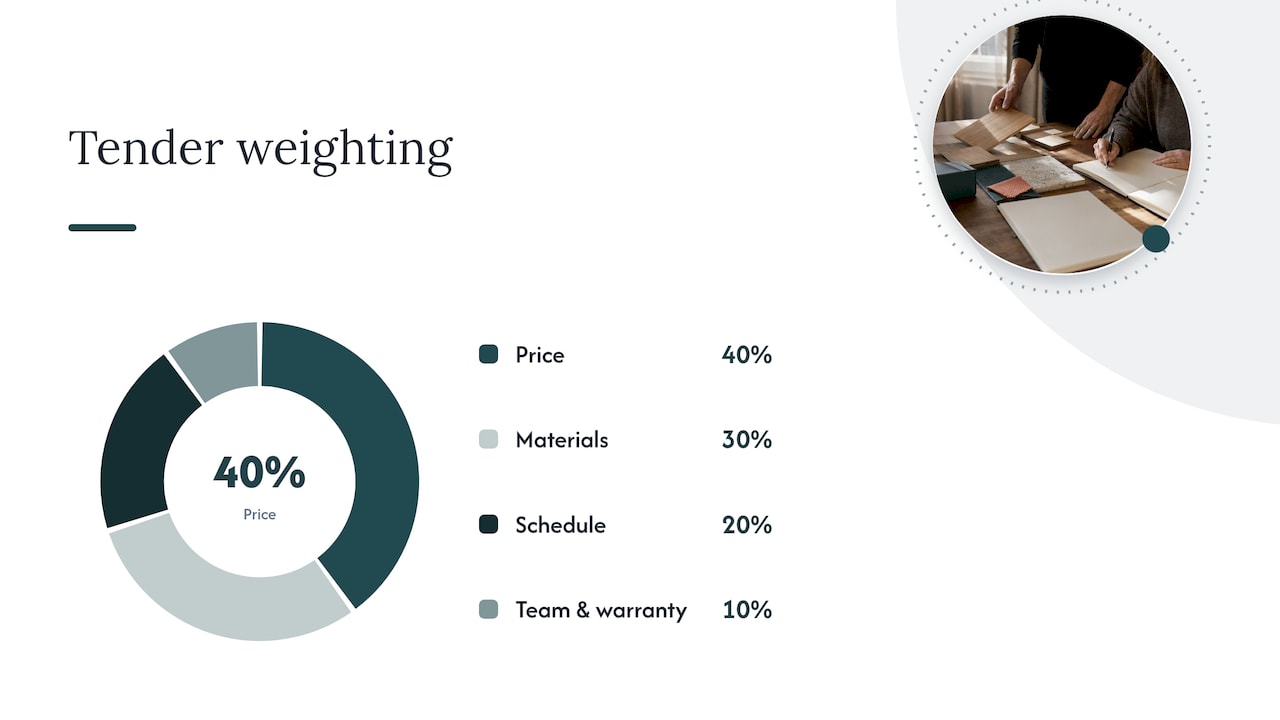
Price matters, but a fit-out lives with its materials and its schedule. A defined weighting keeps the decision honest. A simple example for a private residential project might look like this:
These weights are illustrative, not a rule. Choose your own, write them down before you open the offers and don't change them afterwards. Public bodies are bound to publish theirs, as the City of Zurich guidance makes clear.
After the decision, inform unsuccessful bidders politely and promptly. On public tenders they can appeal, so the reasoning behind your score needs to be documented.
Finding fit-out tenders if you're a bidder
If you're a contractor, joiner or planner looking for projects rather than issuing them, there are two routes.
- Public tenders: these are published on SIMAP, the national platform, and project codes such as BKP 277 appear in listings.
- Project monitoring: Baublatt's Infomanager tracks private, commercial and public construction projects across Switzerland at different stages and lets you save individual search profiles.
Before you commit, run the fit check the Canton of Zurich recommends: not every tender is suitable, so weigh the effort and the realistic return against your capacity. The canton also advises assigning a project manager, cost estimator and quality controller, and setting internal deadlines ahead of the official one, because a missed deadline means automatic disqualification.
Our perspective: design first, tender second
We've worked on more than 480 projects, and the pattern is consistent. Tenders go wrong when the design is still moving. If the layout, lighting concept and material palette aren't settled, every bidder fills the gaps with their own assumptions, and you pay for those assumptions later as variation orders.
Our advice is to invest in the design package before the tender. A coordinated set of plans, a material schedule and 3D visualisations let you see the finished space and let every trade price the same picture. Because we combine architecture and interior design, we can draw the technical details that a bill of quantities depends on, and we also source furniture and finishes through a network of over 185 high-end brands, so the specified products are actually obtainable when the trades need them.
Whether you tender five trades or fifty, a calm, well-prepared process feels very different from one run on a deadline. It's one of the biggest game-changers in a renovation.
— Giorgia D'Amico
How we can help with your project
If you're preparing a fit-out and want the design settled before you ask for offers, our interior design packages start with a CHF 490 consultation. A Single Area Package costs CHF 970 and a Full Home Package CHF 3,390, all one-off prices, and larger or more complex briefs can go through an individual offer. For offices, developments and rental properties, see our commercial interior design services. Our Zurich interior design page shows how we work locally.
For developers, our article on the role of interior designers in development projects explains where design input pays off most in the programme.
FAQ
Do I have to publish a tender for my interior fit-out?
Only public bodies are bound by procurement law. As a private owner or developer you can invite offers from selected trades. A structured process with identical documents for every bidder still gives you far better comparisons.
What does BKP 27 or 28 mean on a tender?
They're cost groups of the Swiss building cost plan that cover interior finishing works (Ausbau 1 and Ausbau 2). They help define the scope of each trade clearly. The detailed list of positions in each group is always set in the project's own documents.
How long do bidders get to respond?
On public tenders the deadline is regulated. For an open procedure under state treaty rules, at least 40 calendar days after publication on SIMAP apply, according to the City of Zurich guidance. For private tenders you decide, but give trades enough time to measure, ask questions and price properly.
Is the cheapest offer always the one to choose?
No. Swiss public procurement aims at the most advantageous offer, and you can do the same privately by weighting quality, schedule and references alongside price. A very low offer is a reason to check that the full scope is included.
Sources
- FM Monitor Wiki: Grund- und Mieterausbau
- Stadt Zürich: Wegleitung Beschaffung von Planungs- und Werkleistungen
- Ordinance on Public Procurement (PPO)
- Canton of Zurich: Tenders
- Competitions Espazium: call for offers, Estavayer-le-Lac
- Baublatt: Innenausbau, Aufträge und Ausschreibungen
- Haus-Forum.ch: Handwerkerofferten vergleichbar machen
Recommended
- Office Acoustics in Zurich
- Interior Design Zurich | Swiss Interior Architects
- The Role of Interior Designers in Development Projects