.svg)

Your childhood home set a design blueprint in your brain before you ever chose a paint color. The layouts you moved through, the light that filled certain rooms, the textures you touched every day — all became an unconscious template for what feels “right” in a home as an adult. Life-course research confirms that emotional memories from childhood predict adult residential satisfaction more strongly than economic conditions. And interviews with interior architects show that professionals routinely echo their first homes — large windows, open kitchens, cozy reading nooks — in the spaces they design decades later.
Start here: Pull up the earliest photo of your childhood home you can find, or close your eyes and sketch its floor plan from memory. Note which room felt safest, which felt too exposed, and what material or color you remember most vividly. That five-minute exercise is your personal style map.
- The role of childhood home in style preferences is not sentimental — it’s neurological and spatial.
- Upscale Interiors helps Bern homeowners decode those memories and translate them into adult-ready interiors.
Which physical elements from your childhood home influence your taste most?
Light comes first. If your childhood home had generous south-facing windows, you likely feel unsettled in dim apartments. Research on spatial impressions shows that openness versus closedness experienced early in life forms lasting attitudes toward layout and boundaries — which is why some people crave open-plan living while others find it exhausting.
Color and texture run a close second. The terracotta walls of a grandmother’s kitchen or the cool linen of a Scandinavian bedroom become sensory anchors. Furniture scale matters too: a childhood spent in rooms with low, human-scale furniture often produces adults who find oversized statement pieces uncomfortable rather than impressive. Rituals — Sunday dinners at a round table, reading in a window seat — encode spatial preferences just as powerfully as aesthetics do.
Does parental warmth really affect how you decorate as an adult?
Yes, and the evidence is striking. MIDUS life-course research finds that perceived parental warmth and acceptance predict higher adult residential satisfaction more strongly than childhood income or housing quality. A separate replication study found that greater perceived maternal acceptance in childhood correlates with a preference for more complex, layered artistic design in adulthood.
Residential stability plays its own role. Swiss coverage on childhood moves links frequent relocations to adult preferences for permanence and controlled environments. If you moved often as a child, you may gravitate toward grounding design choices: a consistent material palette, heirloom-quality anchor pieces, and a clearly defined “home base” zone.
How do you translate those childhood influences into your home today?
The goal is to honor the emotional association, not replicate the object. Three moves work reliably:
- Identify the feeling, not the furniture. Did your favorite room feel cozy because of low lighting, warm wood, or simply its small scale? Recreate the feeling with adult-quality materials.
- Re-scale for your current space. A childhood memory of a grand fireplace can translate into a statement stone wall panel — same warmth, proportionate to a Bern apartment.
- Choose quality over nostalgia. Practical design guidance recommends elevating childhood colors and textures into refined, durable versions so the result reads sophisticated rather than sentimental.
Pro Tip: Build a moodboard with one image of your childhood home alongside three images of interiors you currently love. The overlapping elements — repeated colors, similar furniture heights, comparable light levels — reveal your true aesthetic DNA.
What are the common pitfalls when decorating from childhood memory?
The biggest trap is replicating a dysfunctional pattern without realizing it. If your childhood home felt cold and formal, you might unconsciously recreate that atmosphere because it feels “normal,” even though it never felt good. Architectural psychologist Elke Reitmayer warns of a related issue: the “being-on-stage” effect, where large windows or open sightlines that seemed desirable create chronic discomfort because they undermine privacy and regeneration.
The fix is intentional contrast. If your childhood home lacked warmth, name that gap explicitly and design toward the opposite. For privacy concerns, room divider solutions can soften an overly exposed floor plan without structural renovation.
When should you hire a designer for a Bern project?
Hire a designer when the gap between what you want and what you can articulate becomes frustrating. Clients often cannot name why they prefer certain textures or lighting levels — those preferences function as self-regulation strategies shaped by childhood, and a skilled designer can surface them through structured conversation and psychological design methods.
For a full residential project in Bern, expect a timeline from concept to completion that varies depending on scope. Upscale Interiors offers both full-service project management and fixed-price online consultation packages, so you can engage at whatever level fits your situation. The advantages of hiring a designer become especially clear when childhood influences and current lifestyle needs pull in different directions.
What psychological theories explain why childhood shapes your aesthetic?
Two frameworks are most useful here. Imprinting theory, advanced in the Prime Aesthetic Theory for Dress from WashU Medicine, proposes that sensitive developmental phases create lasting aesthetic preferences that persist into adulthood — essentially, early exposure “stamps” a preference template. Attachment theory extends this to space: the emotional security (or insecurity) you felt in your first home shapes how you respond to spatial cues like enclosure, light, and threshold.
Design researchers Celebi and Hasırcı describe interior designers as “architects of memory” — every space encodes future memories and should be built with psychological sensitivity. That framing redefines decorating from a style exercise into something closer to self-care.
Real examples: how different childhood homes shape adult style
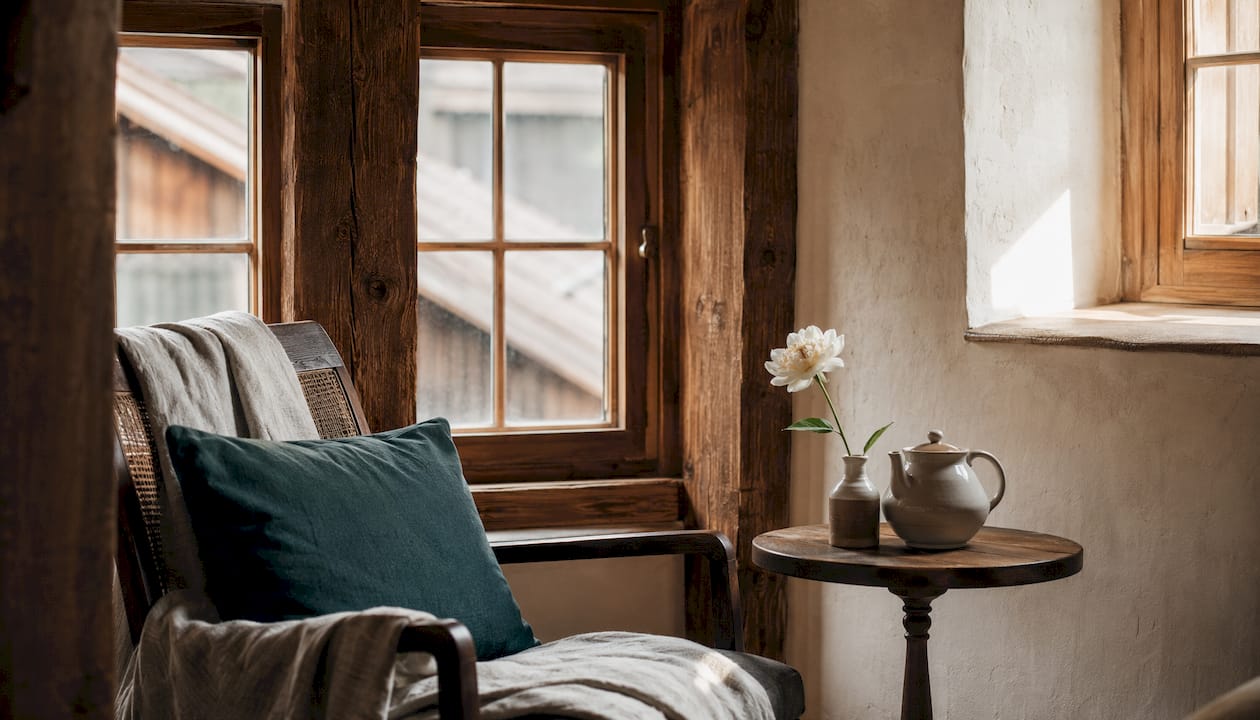
A client who grew up in a traditional Swiss farmhouse with exposed timber beams and deep-set windows consistently gravitates toward warm, natural materials and layered textiles — even in a contemporary Bern apartment. The childhood spatial logic persists, even when the aesthetic vocabulary is updated.
Upscale Interiors’ Colorful Kids Home project in Bern illustrates the reverse: parents who grew up in austere, minimalist homes deliberately chose saturated color and playful pattern for their children’s spaces, consciously breaking the cycle. Both directions — honoring and consciously departing from childhood influences — are valid design strategies. The recurring significance of the childhood house in identity formation means neither choice is trivial.
How do you blend childhood influences with your life today?
Start by separating what you loved from what you simply knew. Make a short list: three elements from your childhood home you genuinely want to carry forward, and two you’re ready to leave behind. Then map each “keep” element against your current lifestyle. A love of cozy, enclosed reading nooks translates beautifully into a Bern apartment — a love of sprawling garden views may need creative reinterpretation through large mirrors or a well-placed terrace.
Current Swiss design trends toward wellness-focused, calm spaces align well with childhood-informed design: natural materials, considered lighting, and spaces that support both social ritual and private retreat. You don’t have to choose between memory and modernity.
How do you add meaningful childhood elements without creating clutter?
One object per memory is the practical rule. Rather than filling a shelf with every inherited piece, choose the single item that carries the most emotional weight and give it a prominent, intentional placement. Pair it with contemporary surroundings so it reads as a curated choice, not an accumulation.

For furniture, customized pieces let you commission an adult-scale version of a childhood favorite — a window bench, a built-in bookcase — without importing the original’s dated proportions. Function must come first: if a cherished element disrupts circulation or storage, find a way to reference it visually (a color, a material, a silhouette) rather than placing the object itself.
Upscale Interiors brings your childhood influences to life in Bern
Your memories deserve more than a mood board pinned to a wall. Upscale Interiors gives Bern homeowners a structured, design-led process to turn those childhood spatial memories into a home that genuinely feels like yours. From a style quiz that surfaces your aesthetic DNA to full space planning, material selection, and 3D visualization that lets you see the result before a single piece moves, the process is built for people who know something is missing but can’t quite name it yet. The Colorful Kids Home project in Bern is one example of how childhood-informed design translates into a space that’s both personal and polished. Ready to find out what your childhood home has been telling you? Book a consultation call and bring your floor-plan sketch.
Key Takeaways
Your childhood home’s layouts, sensory cues, and emotional atmosphere form a lasting blueprint that shapes adult style preferences more powerfully than conscious trend-following ever will.
Recommended
- Summer Home Decor Ideas for a fresh breeze
- Colorful Kids Home | Bern, Switzerland | Upscale Interiors AG
- Upscale Interiors – Swiss Interior Designers | Stylish Spaces
- Choosing A Right Fabric Blog | Upscale Interiors