If your living room sounds hollow, with voices bouncing around and the TV turning to mush, you can usually fix it with a short list of changes. Add soft, heavy and uneven surfaces, place them where sound actually bounces, and add discreet acoustic panels only where they're still needed. You don't have to turn your home into a recording studio. In a well-designed Zürich apartment or lakeside house, good acoustics should feel like quiet comfort, not like a treatment.
This guide explains why modern rooms echo, how to find the cause in ten minutes, which fixes come first, and how to keep everything looking as polished as the rest of your home.
Upscale Interiors
Bring calm to your living room
Upscale Interiors creates tailored residential spaces, with furniture sourcing, material selection and space planning for homes in Switzerland and Europe.
TL;DR
- Echo comes from hard, bare surfaces such as glass, stone, plaster and parquet. The cure is to add soft, textured, absorbing materials, not to block sound.
- Start with a large rug, lined curtains, upholstered seating and filled bookshelves before you buy any panels.
- Acoustic panels work best against echo and sharp reflections. They do little against boomy bass or noise from the neighbours.
- Absorbing sound inside a room (room acoustics) is a different job from keeping sound out (sound insulation). Choose the fix that matches your problem.
- For new builds, open-plan spaces or persistent problems, a measurement by a building-physics specialist saves guesswork.
Why modern living rooms echo
Sound doesn't stop when it reaches your ears. It hits the walls, ceiling and floor, bounces back and keeps travelling. Researchers describe reverberation as the result of speech sound being reflected again and again off a room's boundaries, leaving repeated copies of the sound in the room. Those copies smear speech over time and can mask the direct sound you actually want to hear.
That's why a freshly delivered, nearly empty apartment sounds like a chapel, and why the same room feels calmer once the sofa arrives. Many of the homes we work on in Zürich share the same ingredients:
- Floor-to-ceiling windows with views of the lake or the Üetliberg
- Polished screed, stone or large-format tile floors
- Smooth plastered walls and high ceilings
- Minimal furnishing, because the owner wants an uncluttered look
Every one of these is lovely to look at, and every one of them reflects sound. Open-plan layouts make it worse, because the kitchen, dining area and lounge share a single volume of air and everything you do in one zone is heard in the others.
So the goal is simple. You want a room where conversation is easy, music sounds warm and the TV is clear at a sensible volume, without anyone raising their voice.
Room acoustics or sound insulation? Know which one you need
People often search for a fix for "noise" when they're actually describing two separate problems.
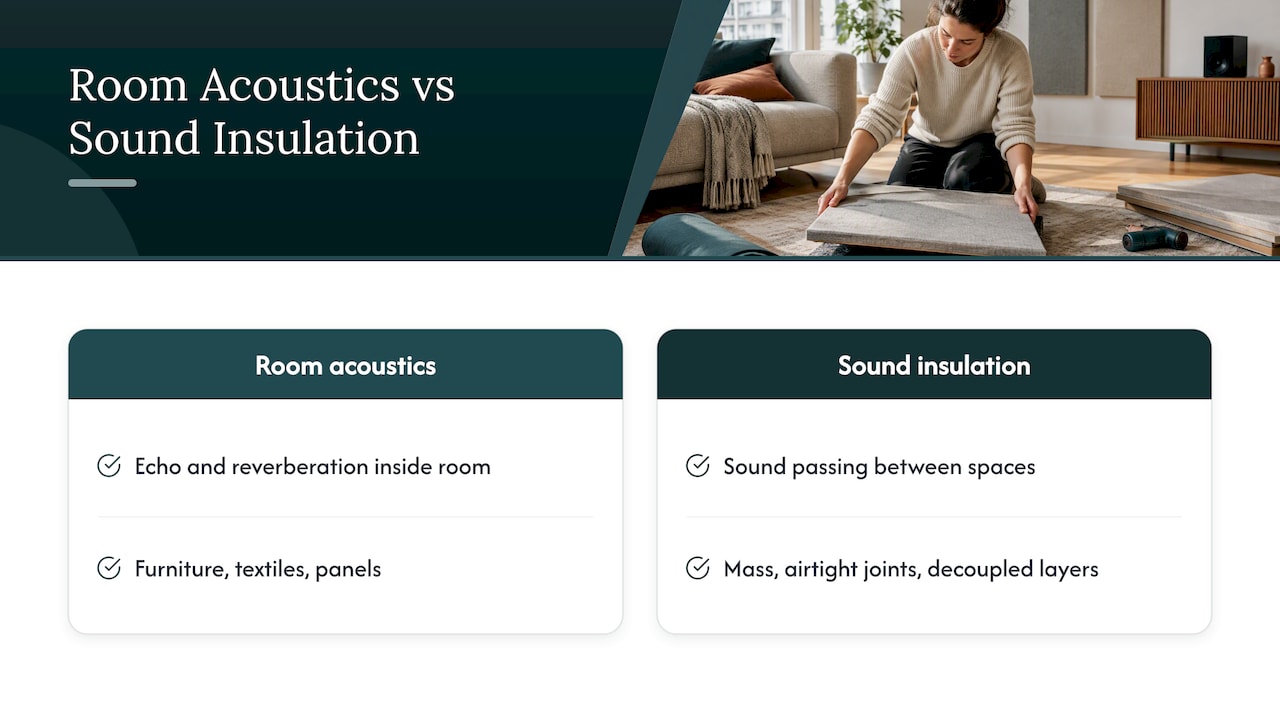
Room acoustics is about how sound behaves inside your room: echo, reverberation, harsh voices, muddy music. Furniture, textiles and panels help here.
Sound insulation is about stopping sound from passing between spaces: the neighbour's footsteps, the tram outside, a TV through the wall. That needs mass, airtight junctions and decoupled building layers, which is a construction job, not a styling job. A cushion or a wall panel changes how your room sounds, but it won't turn a thin party wall into a thick one.
The distinction matters in Switzerland because the building rules treat homes seriously. The federal Noise Abatement Ordinance classifies rooms in dwellings as noise-sensitive rooms, with exceptions such as kitchens without a living area, washrooms and storage rooms. In early 2026 the Federal Office for the Environment also announced that housing in noise-affected areas can be approved under certain conditions, for example with controlled ventilation where limits can't otherwise be met at reasonable cost. If your main complaint is traffic or a neighbour, talk to your landlord, your property manager or a building-physics expert first. Interior styling will make the room nicer, but it won't be the whole answer.
If your complaint is "it sounds echoey in here", read on. That's squarely something good interior design can solve.
Listen first: a ten-minute diagnosis
Before you buy anything, walk through the room like a sound editor.
- Clap once in the middle of the room. A short, dry clap is good. A ringing, fluttering tail means too many hard, parallel surfaces.
- Talk across the room at normal volume. If you have to repeat yourself or the words blur, you have too much reverberation.
- Play familiar music and sit in different seats. Listen for harsh voices or cymbals, and note whether the bass changes dramatically from one seat to another. Strong changes in bass between seats point to low-frequency room behaviour rather than simple echo.
- Check the empty zones. Stand near bare glass, then near the sofa. The difference tells you where your soft surfaces are working and where they're missing.
- Note what bothers you. Is it echo when people talk, a drumming bass, or noise coming from outside? Each has a different cure.
Write your notes next to a rough floor plan. They'll help you, and they'll help any designer or acoustician you later speak to.
Start with soft furnishings
The cheapest and most beautiful fixes are the ones that already belong in a well-designed living room. You're not adding "acoustic products". You're choosing furnishings that do two jobs at once.
A large rug, placed with intention
A rug is the single biggest win in a room with hard floors. Go bigger than feels natural: the front legs of every seat in the seating group should sit on it. A thick, dense weave with a felt or rubber underlay absorbs more than a thin flatweave. In wool or wool-silk blends it also looks the part in a high-end interior.

Curtains that do more than frame the view
Floor-to-ceiling glass is the classic Zürich echo trap. Heavy, lined curtains hung with generous folds, ideally a little way from the glass, soak up reflections in the mid and high frequencies. If you love the view and don't want to lose it, use double tracks: a sheer layer for daylight and a heavier layer you can draw in the evening, when you're most likely to watch a film or host dinner.

If you already have shutters or blinds, plan the layers together. This guide on layering curtains with shutters shows how the clearances work, and the same logic helps you keep a heavy curtain fold from fighting your window hardware.
Upholstery, cushions and throws
Sofas, armchairs, ottomans and bouncy cushions are broad absorbers. A deep sofa and a couple of upholstered chairs often do more than you'd expect. Add a wool throw and a few textured cushions, and a bare room starts to feel cosy almost instantly. If you're redoing the whole room, our guide to how to decorate your room shows how to layer these elements without making the space feel crowded.
Bookshelves, art and plants
Filled bookshelves scatter and absorb sound at the same time, which makes them ideal on a long bare wall. Large textile art, wall hangings, sculptural objects and plants break up flat reflections too. Unevenness helps: sound bounces less predictably off something with depth than off a flat plaster wall.
Don't overdo it
A room can sound too dead. Too short a reverberation time can make a space feel sterile, just as too long a one hurts speech clarity, which is something acoustic consultants also point out. You want warmth and life in the sound, not a muffled box. Add soft surfaces in stages and listen after each step.
Acoustic panels in an apartment
If soft furnishings aren't enough, or the room has large bare walls and a high ceiling, acoustic panels are the next step. Retrofit options include wall panels, suspended acoustic ceilings, ceiling baffles and acoustic walls. In a flat, wall panels and ceiling elements are usually the realistic choice, and many can be fixed without major building work. Check your tenancy agreement first if you rent, and ask your landlord about drilling or gluing.
Where panels help, and where they don't
The lesson is to match the measure to the problem. A wall panel helps little against heavy bass build-up, and no panel will stop your neighbour's stereo.
Practical planning points
- Spread them out. Several elements placed on different surfaces work better than one large block on a single wall.
- Cover reflection points. Sit in your usual spot and have someone slide a mirror along the side walls: where you can see the speakers or a window in the mirror, a reflection hits you.
- Use the ceiling. In high rooms, the ceiling is the biggest bare surface. Ceiling panels or a slim suspended element often do more than yet another wall panel.
- Mind the thickness. Thicker absorbers work lower in frequency. Thin felt mainly tames high frequencies.
- Pick finishes you'd choose anyway. Fabric-wrapped panels in your wall colour, timber slats over an absorbing backing, or panels printed with art blend into the scheme.
The bass problem
Low notes behave differently. Long bass wavelengths need a lot of material to be absorbed, so thin textile solutions don't touch them. Rugs and curtains mainly work on higher frequencies. Some practical guidance from audio specialists: keep speakers off the wall, and don't push a subwoofer into a corner. If a room has pronounced low-frequency resonances, deep absorbers or bass traps in the corners can help.
For a home cinema or a dedicated listening room, this is where a measurement and a plan are worth the effort. Our idea collection for luxury home cinemas in Montreux shows how technical needs can be built into a space that still looks beautiful. For an everyday living room, a good rug and furniture layout usually take you most of the way.
Keep it beautiful: acoustics as part of the design
The fear we hear most is, "I don't want my lovely living room to look like an office." Fair. The answer is to treat acoustics as part of the material palette from day one, not as an afterthought.
- Choose textures that earn their place. Bouclé, wool, linen, velvet and felt are all absorbers, and all very much on trend.
- Hide the function in joinery. Slatted timber with absorbing backing, fabric-lined niches and upholstered headboards or bench seats can quietly handle sound.
- Work with colour. A panel in the same tone as the wall disappears. A deliberate accent panel can become the feature.
- Think in zones. In an open-plan space, use furniture and dividers to break the room into a lounge, a dining area and a work corner. Our ideas for room dividers without renovation also reduce how far sound travels across the floor.
- Layer the lighting too. Fabric lampshades, textured pendant shades and a considered lighting plan for your living room add softness to the scene and sound.
- Plan the TV wall as one piece. A media wall with felt, fabric or slatted elements keeps reflections around the screen under control.
If you work from home in the same room, the stakes rise, since calls need clear speech. Our piece on integrating a home office covers how to carve out a quieter corner, and the principles in our guide to office acoustics in Zürich apply at home too.
A step-by-step plan for your living room
- Run the ten-minute listening test and note the problems.
- Add the big soft items first: rug, lined curtains, upholstered seating.
- Fill a bookshelf or add textured art on the barest wall.
- Listen again. If speech is clear and the room feels warm, stop there.
- If echo remains, add panels on the wall and ceiling surfaces nearest the seating area, in your room's colours.
- If bass is the issue, rethink speaker and subwoofer placement, then consider thicker absorbers.
- If the problem is noise from outside, call a specialist for insulation measures.
Perspective
Acoustics is the part of a home that nobody photographs and everybody feels. When a client says a room is "beautiful but somehow tiring", the cause is often a hard, echoing space, not the design itself.
We approach it as architecture and interior design together. Before we choose a single material, we look at the room's proportions, the glass, the floors, how the family actually uses the space, and where people sit and talk. Then the sound gets planned like the light: layered, balanced and invisible when done well. A wool rug, a curtain with the right weight, a walnut slat wall with an absorbing back, a sofa placed so that conversation feels natural. These are design decisions first and acoustic ones second, and that's why they never look like add-ons.
What we'd tell any homeowner: don't buy panels in a panic. Listen, start soft, add precisely, and don't let an echo make you settle for a room that feels less than you hoped. With our network of European furniture and textile brands and our project management, we can deliver the result as one coherent scheme.
Giorgia D'Amico
When to bring in a specialist
Most living rooms can be fixed by design alone. A professional assessment is worth it in these cases:
- You're building new or renovating, and can plan ceilings, walls and floors before they're closed up.
- The room is large, double-height or very open-plan, so a quick fix isn't enough.
- You have a dedicated cinema, music or listening room.
- You suspect neighbour, impact or installation noise, where subjective listening can mislead.
Building-physics firms offer room-acoustics measurements, reverberation-time requirements and sizing of measures, as well as sound-insulation measurements for airborne, impact and building-services noise. A typical visit involves checking the room on site, measuring, and recommending measures in priority order. A designer then turns those recommendations into something that suits the space, which is how we usually work with clients who have an acoustic report in hand.
How we can help
If you'd like a designer's eye on your living room, we offer fixed-price online packages. A Single Area Package costs CHF 970 and covers one room, which suits a living room that needs a calmer, cosier scheme. A Full Home Package costs CHF 3,390 for the whole home, and a one-off consultation costs CHF 490. You can see all options on our interior design packages page. For larger homes, holiday homes or commercial spaces, we also work on individual offers with full project management.
FAQ
How can I improve my living room acoustics without panels?
Use a large, thick rug, heavy lined curtains, upholstered furniture and filled bookshelves. These soft and uneven surfaces absorb and scatter sound, and they're pieces you'd want in a stylish living room anyway. Add them step by step and listen after each change so the room doesn't end up too dull.
Will acoustic panels reduce noise from my neighbours?
No. Panels improve how a room sounds by reducing echo, but they don't block sound coming through walls or floors. Stopping that kind of noise needs construction measures such as mass, sealed junctions and decoupled layers, so speak to your landlord or a building-physics specialist.
Why does my new apartment echo so much?
Bare floors, smooth walls, large windows and few furnishings leave sound nowhere to go, so it keeps bouncing. Once a sofa, rug, curtains and shelving arrive, the echo usually drops noticeably. Open-plan layouts and high ceilings make the effect stronger.
Do rugs and curtains help with bass?
Not much. They mainly absorb higher frequencies, while bass needs thick absorbers or careful placement of speakers and subwoofers. If your problem is booming low notes, keep speakers away from walls, avoid corners for the subwoofer, and consider a professional measurement.
Can acoustic solutions suit a high-end interior?
Yes. Materials such as wool, felt, fabric-wrapped panels and slatted timber can be chosen to match your colours and architecture. The best results come when acoustics are planned alongside furniture, lighting and joinery from the start.
Sources
- Assessing the Acoustic Characteristics of Rooms: A Tutorial
- Swiss Noise Abatement Ordinance (SR 814.41), English version
- Bundesrat setzt angepasste Lärmschutzverordnung in Kraft, BAFU
- Eine optimale Raumakustik dank Schallschutz und Raumdesign, wohnakustik GmbH
- Leistungen, BWS Bauphysik
Recommended
- Office Acoustics in Zürich
- Modern Family Room Design Ideas for Oberägeri Homes
- Luxury Home Theater Design Ideas for St. Moritz Homeowners