.svg)

Bespoke lighting elevates a luxury home by shaping atmosphere, revealing the true character of materials, and giving architecture a sense of hierarchy that stock fixtures simply cannot achieve. The transformation rests on three levers: a layered lighting plan, precise control over colour temperature and CRI, and proper commissioning once fixtures are installed. Firms such as Upscale Interiors build all three into every project, which is why the results tend to look considered rather than decorated.
TL;DR:
- Precise control over colour temperature and CRI ensures materials like marble and wood showcase their true character under bespoke lighting.
- Layered lighting strategies create depth, emphasize architecture, and allow scenes to shift from bright to intimate effortlessly.
- Technical specifications such as dimmer compatibility, serviceable components, and appropriate IP ratings are crucial for reliable, long-term performance.
- Custom fixtures made from handcrafted materials like blown glass or patinated brass last longer and age more beautifully than factory-made alternatives.
- Proper documentation, including reflected ceiling plans and load schedules, is essential to prevent costly adjustments and ensure compliance with local regulations.
How can bespoke lighting elevate homes in Geneva?
Good lighting does something most homeowners underestimate: it changes how expensive materials actually look. A slab of Carrara marble under the wrong colour temperature reads flat and grey. Under the right one, the veining comes alive. The same goes for walnut joinery, boucle upholstery, and hand-plastered walls. Bespoke fixtures are specified with the material palette in mind, not fitted afterwards and hoped for the best.
Lighting also does the architectural work that walls and furniture cannot. It draws your eye up a stairwell, softens a low ceiling, or gives a double-height living space a sense of scale it would otherwise lack. Well-placed accent and architectural layers create hierarchy between a foyer, a dining room, and a private study, so each space feels distinct rather than uniformly lit.
- Material fidelity: correct Kelvin and CRI values make stone, wood and textiles look as intended, not washed out.
- Architectural emphasis: layered light creates depth and draws attention to volumes, not just surfaces.
- Scene control: a single space can shift from bright and functional to intimate and warm at the touch of a control panel.
- Durability: bespoke fixtures avoid the colour shift and premature driver failure common to mass-market lighting, reducing replacement costs over time.
Pro Tip: Walk each room at the time of day you actually use it before finalising fixture positions. A dining room lit beautifully at noon can feel clinical at 9pm without the right accent layer.
What are the stages of the bespoke lighting process?
Commissioning bespoke lighting follows a fairly predictable sequence, and knowing it in advance saves you weeks of back-and-forth with contractors.
- Survey and brief. Your designer needs floor plans, ceiling heights, finish schedules and photographs of existing conditions before anything is drawn.
- Layering and concept. Ambient, task, accent, decorative and architectural layers are mapped against the brief, with early decisions on which walls, ceilings or joinery will carry hidden sources.
- Specification and prototyping. Drivers, dimmers, thermal tolerances and fixture fit are tested, sometimes with physical prototypes for one-off pieces, as is standard in bespoke fixture development.
- Technical documentation. Reflected ceiling plans and load schedules are issued so electricians, joiners and structural trades work from the same reference.
- Installation and commissioning. Fixtures are aimed at site, scenes are programmed, and the system is signed off against the original brief.
Pro Tip: Ask to see the reflected ceiling plan before any wiring goes in. It is far cheaper to move a circuit on paper than to chase it through a finished ceiling.
Which technical specs actually determine the result?
Two homeowners can commission visually similar fixtures and end up with wildly different results, and the difference almost always comes down to specification detail rather than design taste.
Colour temperature should typically sit between 2700K and 3000K for living rooms, bedrooms and dining spaces, since warmer light flatters skin tones and traditional materials far better than the cooler 4000K often used in offices. Colour Rendering Index (CRI) matters just as much: anything below 90 will dull the reds in a painting or mute the tones in a wool rug, so insist on CRI 90 or above wherever art, textiles or skin tone matter.
- Dimming: confirm driver and dimmer compatibility before installation, since mismatched components cause flicker and premature failure.
- Controls: DALI or Matter-based systems allow scenes to be programmed and adjusted long after installation.
- Serviceability: specify replaceable LED modules and front-access drivers so a future repair never means opening a finished ceiling.
- IP ratings: exterior and bathroom fixtures need ratings matched to moisture exposure, not just aesthetics.
Luxury projects following a structured five-layer lighting strategy consistently avoid the flat, single-source lighting that makes even well-decorated rooms feel unfinished.
Do materials and finishes really change the outcome?
They do, and the difference is visible the moment you compare a hand blown glass pendant with a machine-pressed equivalent. Hand-blown glass carries small variations in thickness and bubble pattern that catch light unevenly and beautifully. Alabaster glows rather than glares, since it diffuses light through its natural veining. Solid brass develops a patina over years that a plated finish never will.
Handcrafted, small-batch fixtures are typically inspected and finished by hand, which is why they tend to outlast factory-made equivalents and age with more character rather than less.
- Hand-blown glass: soft, organic light distribution, ideal for statement pendants.
- Alabaster: warm, diffused glow suited to wall sconces and ceiling fixtures.
- Solid brass or bronze: develops patina, pairs well with classic and transitional interiors.
- Matt black or bronzed steel: reads contemporary, works well against stone and concrete.
Semi-custom fixtures, adapted from an existing frame with a bespoke finish or scale change, often deliver most of these benefits with shorter lead times and a lower price than a fully one-off piece.
Is bespoke lighting worth the investment?
Cost is driven by four things: scale, bespoke finishes, electrical complexity, and the sophistication of the control system. A single custom pendant with a hand-finished brass frame costs considerably more than an off-the-shelf equivalent, but the gap narrows once you account for lifecycle costs.
- Modular LED systems with serviceable drivers cut long-term maintenance, since avoiding colour shift and failure rates reduces how often fixtures need replacing entirely.
- A common rule of thumb allocates a meaningful share of a high-end renovation budget to lighting design and fixtures, reflecting how much visual impact it delivers relative to structural work.
- Whole-home bespoke rarely makes sense for every room. Reserve full customisation for the foyer, dining room or master suite, and use semi-custom or quality stock elsewhere.
Bespoke earns its premium fastest in rooms that guests actually see and where materials need flattering, not in utility spaces or guest bathrooms.
What should you ask before hiring a lighting partner?
Vetting a designer or maker properly avoids the two most common failures: fixtures that do not fit the space, and systems nobody can service five years later.
- Ask to see a reflected ceiling plan and load schedule before signing anything.
- Confirm which driver brands they specify and whether dimming compatibility has been tested, not assumed.
- Ask about prototyping and on-site aiming as part of the service, not an optional extra.
- Check lead times realistically, since artisan-made pieces from small workshops can take considerably longer than factory stock.
- Confirm warranty terms and spare-part policy, and whether the partner coordinates directly with your electrician and architect.
Pro Tip: Ask specifically who attends the final commissioning visit. A designer who shows up to aim fixtures in person catches problems a subcontractor working from a drawing never will.
What do bespoke lighting projects in Geneva homes look like in practice?
Geneva’s lakeside villas and grand apartments offer a good illustration of what layered, bespoke lighting achieves at scale. One documented villa project in the region integrated numerous recessed LED sources to achieve uniform ambient light while precisely emphasising specific volumes and materials, a scale of coordination that is only realistic with detailed planning rather than fixture-by-fixture guesswork.
The pattern in these projects tends to repeat. A double-height entrance hall gets architectural uplighting to draw the eye through the space. A formal dining room gets a statement bespoke pendant, hand-blown or metal-finished, paired with dimmable recessed accents so the room can shift from bright family meals to something considerably more intimate. Bedrooms and dressing rooms lean on warmer 2700K sources and hidden joinery lighting, following the growing preference in high-end interiors for invisible light sources over visible fixtures wherever a clean architectural line matters more than a statement piece.
What separates these projects from a standard renovation is the coordination between lighting, joinery and structural trades from the outset, not lighting bolted on once the interior is finished. That sequencing is exactly why the technical documentation stage matters as much as the creative concept.
What rules and standards apply to lighting installations in Geneva?
Electrical installations in Swiss homes, including bespoke lighting circuits, must comply with the national low-voltage installation standard (NIN, based on the SEV/NIBT framework), and any qualified electrician working in Geneva will be familiar with its requirements around circuit protection, load calculation and earthing. This is one of the reasons a proper load schedule matters: it gives your electrician the documentation needed to confirm a bespoke installation meets these requirements before anything is wired in.
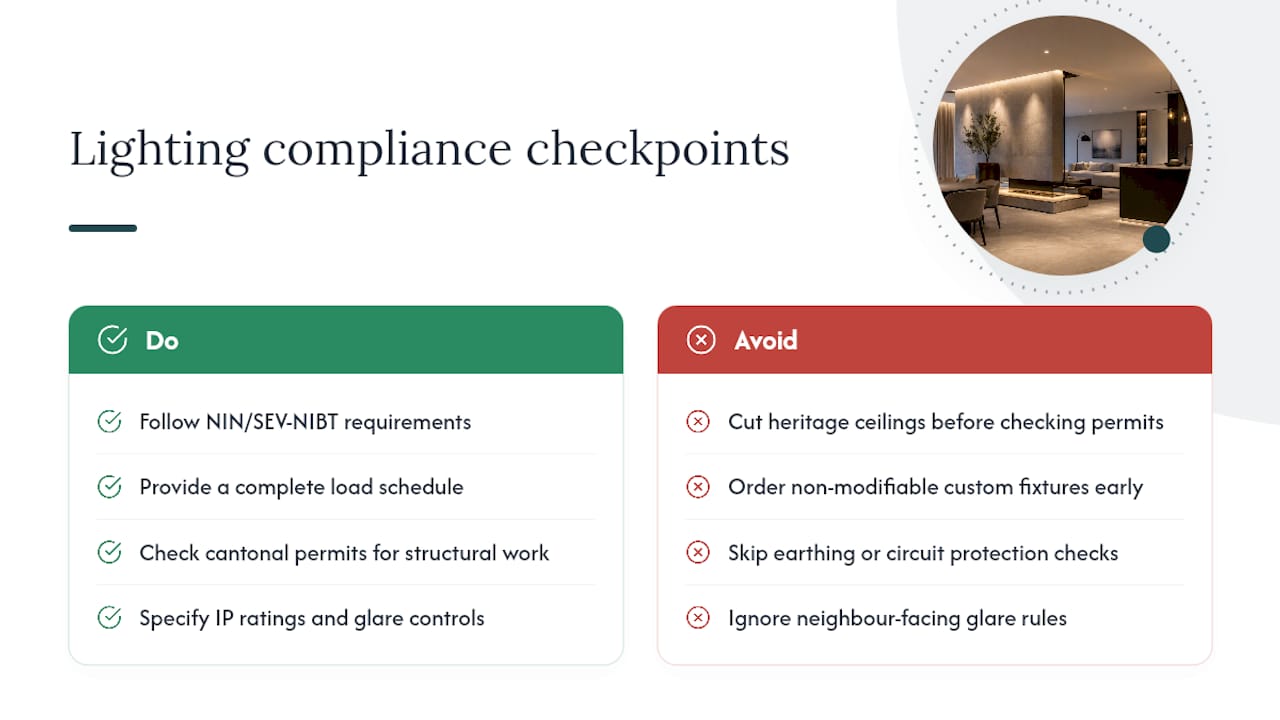
Geneva’s cantonal building regulations can also affect lighting projects that involve structural changes, particularly in older apartment buildings within protected or heritage zones, where alterations to ceilings, facades or shared circulation areas may require permits. If your property sits within a heritage-listed building or a protected historic district, check with the relevant cantonal office before specifying recessed lighting that requires cutting into original ceilings or facades.
For exterior lighting, terraces and garden fixtures need appropriate IP ratings for weather exposure, and any significant exterior lighting scheme should be checked against local light pollution and neighbour-facing glare considerations, which some Geneva communes address through general nuisance provisions. None of this should discourage ambition. It simply means your lighting partner needs to coordinate with a licensed electrician and, where structural changes are involved, confirm permit requirements before ordering custom fixtures that cannot easily be modified later.
How does bespoke lighting suit Geneva’s architectural styles?
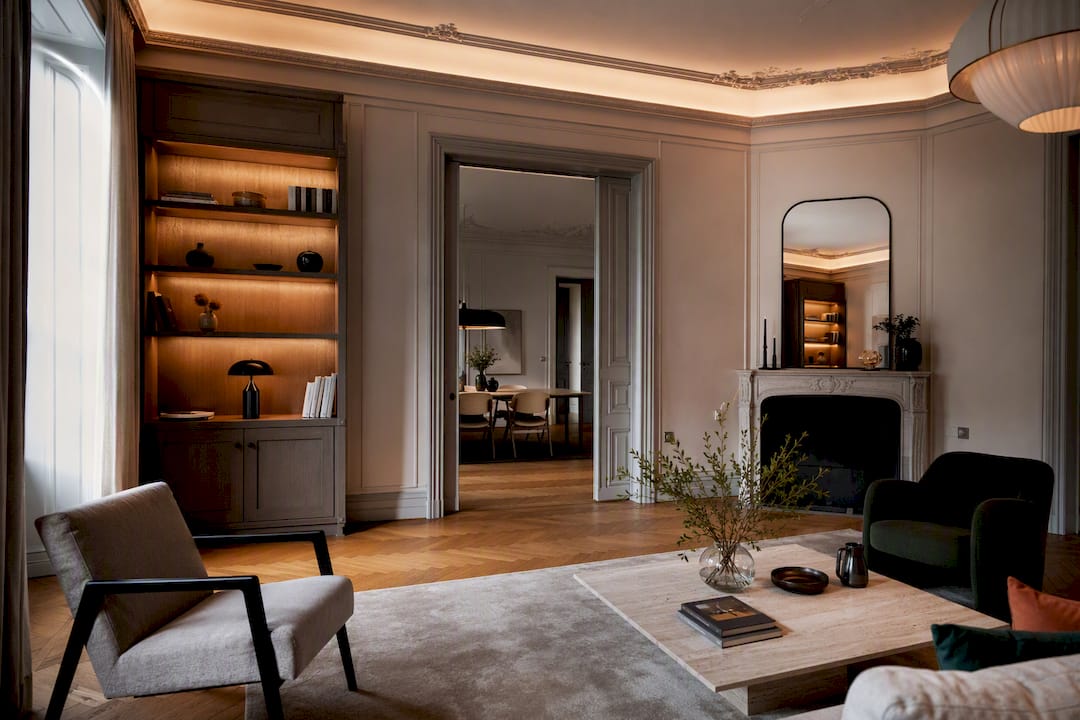
Geneva’s residential architecture ranges from grand nineteenth-century apartments with high ceilings and ornate cornicing to sleek lakeside villas built in a more contemporary idiom, and bespoke lighting has to answer to both.
In period apartments, the temptation is to rely on a single chandelier and call it done. A layered approach instead uses architectural uplighting to highlight cornicing and ceiling detail, task lighting tucked discreetly into joinery, and a statement fixture reserved for genuine visual impact rather than as the room’s only light source. This respects the original architecture instead of competing with it.
Contemporary villas, with their expansive glazing and open-plan volumes, tend to favour the opposite instinct: hidden linear channels, recessed accents and minimal visible hardware, letting the architecture itself read as the design statement. This aligns with the broader shift toward invisible light sources in high-end interiors, where the fixture disappears and only the effect remains.
Both approaches share the same underlying discipline: colour temperature, CRI and fixture placement are decided in relation to the existing materials, whether that is a hundred-year-old parquet floor or a polished concrete kitchen island. Get that relationship wrong and even the most expensive fixture looks like an afterthought.
Upscale Interiors’ perspective on getting bespoke lighting right
The biggest mistake homeowners make with bespoke lighting is not choosing the wrong fixture. It is skipping the documentation stage because it feels like unnecessary paperwork for something as simple as a light fitting. It is not simple, and treating it that way is how projects end up with fixtures that do not fit the ceiling void, drivers nobody can service, or scenes that never quite match the brief.
On a recent Geneva residence, the brief called for a formal dining room that needed to work equally well for a quiet family dinner and a twelve-person gathering. The solution combined a hand-finished brass pendant, sourced through the kind of small artisan workshops that specialise in bespoke architectural pieces, with a recessed accent layer on a separate dimming circuit. The result was a room that shifts convincingly between two very different moods without anyone touching a light switch beyond a single scene button.
Upscale Interiors approaches every bespoke lighting brief the same way: full reflected ceiling plans and load schedules before procurement begins, factory quality control on artisan-sourced pieces, and an on-site commissioning visit to aim and programme scenes properly. Our style quiz and showroom access give clients a starting point for material and finish preferences before the technical work even begins, which tends to make the whole process feel far less abstract.
— Giorgia D’Amico
How Upscale Interiors can help you get bespoke lighting right
There are other routes to bespoke lighting: independent lighting designers, specialist electricians, or sourcing fixtures directly from artisan workshops yourself. Each demands you coordinate the moving parts, materials, electrical trades and technical documentation, on your own. Upscale Interiors offers a different route: one team managing the survey, the 3D visual concept, the reflected ceiling plans, procurement, and final installation, so nothing gets lost between a designer’s sketch and an electrician’s wiring diagram.
Before a first meeting, it helps to gather floor plans, a rough material palette, and photographs of the rooms you want to transform. From there, Upscale Interiors handles 3D visualisation so you see the lighting concept before a single fixture is ordered, alongside project management that keeps procurement, joinery and electrical trades working from the same documentation. For readers exploring trade access to specialist finishes and joinery alongside lighting, designer trade programmes are worth understanding as part of the wider procurement picture.
If you’re ready to discuss a bespoke lighting scheme for your Geneva home, book an interior design consultation with Upscale Interiors and bring your plans, your palette, and your priorities. The rest is what we do well.
Sources
- Standard vs. Custom Lighting: Evaluating the ROI for High-End Projects
- Handcrafted lighting vs factory: the difference you can see | Hammerton
- Bespoke lighting — Manooi
Recommended
- Glass Luminaries: Still on Trend
- Lighting Plan for Your Living Room
- Home Office Lighting: Perfect for your Home Office
- The Right Lighting in the Study