For a home in Zürich, the honest answer is that neither label beats the other. Swiss federal guidance treats both as credible proof of sustainably sourced wood, so the better question is whether the specific floor, wardrobe or dining table you're buying can prove its certification from forest to showroom. Below we explain how FSC and PEFC differ, where the Swiss Wood Label fits in, and how to apply all of this to solid wood and veneer.
Upscale Interiors
Choose Timber With Confidence
Upscale Interiors offers bespoke interior design and material selection for residential and commercial spaces in Switzerland and Europe.
TL;DR
- FSC and PEFC are both accepted as evidence of sustainable wood in Switzerland, including in federal guidance on Swiss wood. Neither is "the" winner.
- FSC is one global standard. PEFC endorses national systems, so its rules can be adapted to local forests.
- Ask for chain of custody proof on the actual product. A label on a brochure is not enough.
- The Label Schweizer Holz is a different promise: domestic origin and local value creation, not a rival to FSC or PEFC.
- Solid wood and veneer can both be certified. What matters is the paperwork behind the core, the veneer and the glue-up.
What FSC and PEFC actually are
Both labels exist to help buyers tell responsibly managed forests from over-used ones. According to the Swiss forest industry's overview of timber labels, FSC and PEFC are the two labels that dominate the market worldwide, with the Label Schweizer Holz established alongside them in Switzerland.
The differences are mostly about how each system is built.
FSC (Forest Stewardship Council) is a non-profit founded in 1993 after the Rio Earth Summit. It works with one globally standardised framework and a multi-stakeholder structure. FSC Switzerland describes a "three-chamber system" that balances ecological, social and economic interests, which is why it often appeals to clients who want a uniform, tightly monitored standard.
PEFC (Programme for the Endorsement of Forest Certification) was founded in 1999 and acts as an umbrella for national certification systems. That lets standards reflect regional conditions while still meeting international thresholds. PEFC Switzerland's forest standard is written for Swiss topography and Swiss forestry. Among its rules are a ban on clear-cutting and the mandatory use of biodegradable lubricants for forestry machinery.
In Switzerland, PEFC certification covers roughly 220,000 hectares, about 18 per cent of the country's forest, according to the BAFU fact sheet cited above. Many Swiss sawmills hold chain of custody certificates for both systems, as the list of certified Swiss sawmills shows. That is a good clue that the market sees the two as complementary.
Which one do Swiss rules accept?
If you're worried about compliance, here is the reassuring part. The Swiss federal environment office (BAFU) and the KBOB, the coordination body for federal construction and property services, treat FSC and PEFC as equally suitable evidence of sustainable wood sourcing. Both are named in the BAFU's wood sustainability guidance. The BAFU factsheet on assessing wood products explains why sustainably sourced wood matters: it helps preserve the ecological, social and economic functions of forests over the long term.
For building and fit-out work, the same logic applies:
- Minergie-ECO and ecoDevis: wood and wood-based materials should carry a recognised label. ecobau's ecoDevis tools list FSC, PEFC and the Label Schweizer Holz as compliant.
- Joinery tenders: the Swiss NPK 624 standard for general carpentry requires wood from sustainable production, proven by the Label Schweizer Holz and/or FSC or PEFC evidence.
- Public procurement: the canton of Zürich publishes sustainable procurement guidelines for furniture and interior fit-out. They are a useful reference if you want to see how a public body sets its criteria.
One exception to keep in mind: a private client, a developer or a foreign investor can write "FSC only" into a contract. That is a contractual preference, not a Swiss legal rule. If it's in your brief, tell your designer at the start, so the specification is right from the first drawing.
The Label Schweizer Holz: a different question
People often lump the Swiss Wood Label in with FSC and PEFC. It answers another question. FSC and PEFC speak about how a forest is managed. The Label Schweizer Holz, awarded by the timber industry body Lignum, is about origin: wood from Swiss forests, or products with at least 80 per cent Swiss wood, as set out by Wald Schweiz. According to the BAFU factsheet, it also requires that at least 60 per cent of manufacturing costs arise in Switzerland.
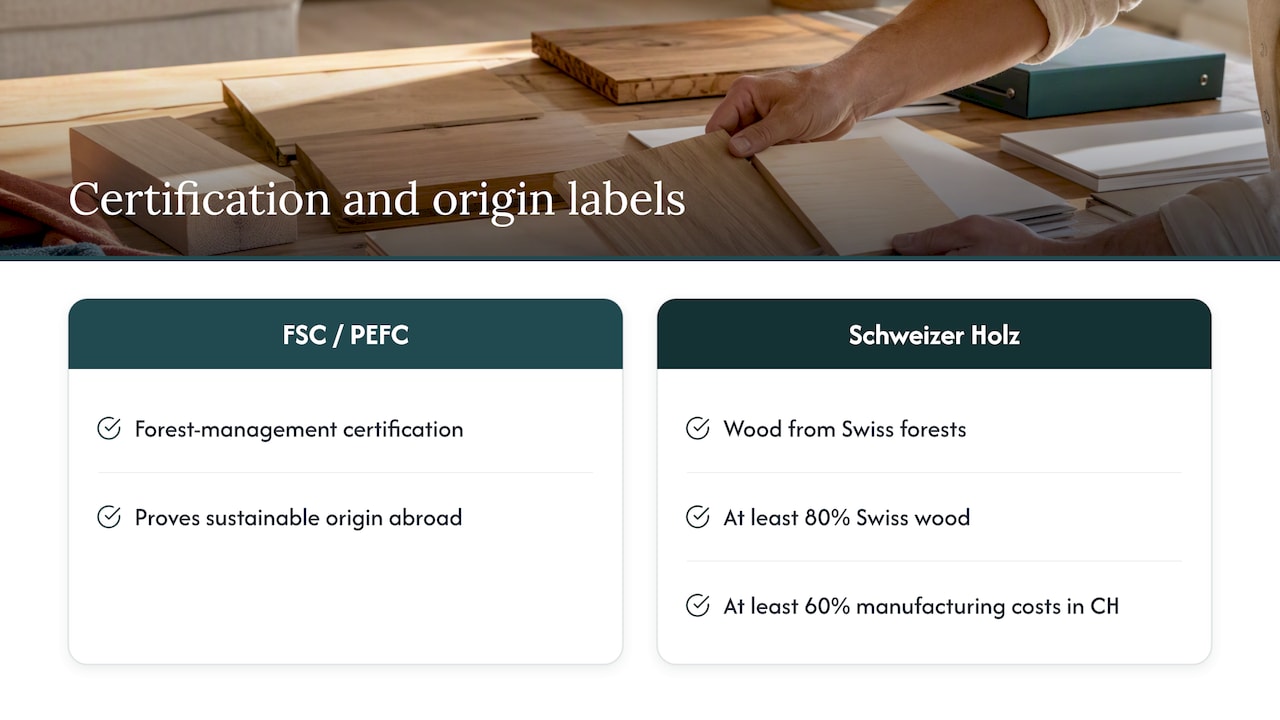
For a Zürich homeowner that can be a lovely story: an oak or larch built-in made nearby, with short transport and local craftsmanship. Combining the labels is common in high-end specification. A pine or oak from Switzerland with the Swiss label is one route. A walnut or teak from further afield with FSC or PEFC is another. For wood from outside Europe, FSC or PEFC is the usual way to prove sustainable origin.
Chain of custody: the part that really matters
Here is the point experts keep returning to. The label on the forest is only half the story. What counts is whether the chain of custody, the documented path from forest to sawmill to workshop to your living room, stays unbroken.
In practice, a few things can go wrong:
- The raw material is certified, the product isn't. A sawmill may be certified, but the cabinetmaker who makes your wardrobe may not hold a chain of custody certificate.
- Mixed sources. Products can contain certified and non-certified material in different proportions, and the claim on the label should say which.
- Swapped materials. A quote specifies certified oak, and the delivered piece uses a different board for the carcass.
So ask for the certificate number of the supplier and the manufacturer, the claim on the invoice or delivery note, and the exact materials covered (solid timber, veneer, panel core). Both FSC and PEFC maintain public databases where you can look up certificate holders. A reputable workshop or furniture house will be happy to supply all of this.
Solid wood or veneer: does the label change the answer?
This comes up in nearly every project. People often assume that solid wood is automatically the green choice and veneer is the compromise. The reality is more nuanced, and we'd rather give you the practical view than a slogan.
Solid wood is wonderful for pieces that take real wear: dining tables, benches, staircases and flooring. It can be sanded and refinished, so it can last for generations. It also moves with humidity, which matters in a heated Zürich apartment in winter, and wide solid boards need good detailing.
Veneer is a thin layer of real wood on a stable core. It lets a precious species cover large surfaces such as wardrobe fronts, wall panelling or kitchen doors, with a consistent grain and less movement. It uses a rare timber more sparingly. The weak point is usually the core and the adhesive, so ask what's under the surface.
Neither is automatically better. A certified veneer on a certified core, made by a certified workshop and built to last for decades, can be a more responsible choice than a short-lived piece made from solid timber of unclear origin. When we plan a project, the question is where each material will be used and how long we want it to last.
Beyond the label: other sustainable materials worth considering
Certified wood is one piece of a sustainable interior. A few other choices make a real difference to a home:
- Durability first. Furniture you keep for twenty years beats a certified piece you replace in five.
- Repairable construction. Look for solid joinery, replaceable hardware and finishes you can renew.
- Low-emission finishes. Water-based oils and lacquers help indoor air quality.
- Reuse. Restored vintage pieces and reclaimed timber skip the new-resource question entirely.
- Swiss and European sourcing. Shorter transport and local workshops keep value close to home.
If you're also weighing recognised environmental benchmarks for a property more broadly, recognised green building labels offer a useful comparison with how Switzerland handles certification.
Our perspective: choose the supply chain, not the logo
We design homes and commercial spaces across Switzerland and Europe, and the FSC versus PEFC debate comes up when clients want sustainability to be part of the brief. Our view is simple: don't spend your energy picking a side. Spend it on three questions.
First, what's the specification? If your project targets Minergie-ECO, or a developer or investor has asked for a specific label, we build that into the plans from the start. Otherwise we treat FSC and PEFC as equally credible, in line with Swiss federal guidance.
Second, where does each piece sit in your daily life? A table your family eats at every day deserves a different material logic than a wall of wardrobe doors. We match solid wood and veneer to the way you live, then verify the certification for each.
Third, can the supplier prove it? We work with a wide network of European furniture makers, well over 150 manufacturers, and we ask for documentation rather than relying on a marketing line. If a piece can't be traced, we tell you and offer an alternative.
That is also why we like to combine design, specification and project management in one team: the sustainability promise survives from the first mood board to delivery and installation.
— Giorgia D'Amico
A practical checklist for your Zürich project
Use this list when you brief a designer, a joiner or a furniture brand.
- Write down your goal. Is it a Minergie-ECO target, a contractual FSC clause, a preference for Swiss origin, or simply peace of mind?
- Name the rooms and surfaces. Floors, kitchen fronts, built-ins and loose furniture may each need a different approach.
- Ask for certificate numbers. Both the material supplier and the final manufacturer should be listed.
- Check what is covered. Solid timber, veneer, core board and edging can each have different claims.
- Request the claim on the paperwork. The quote, the invoice and the delivery note should carry the certification wording.
- Consider the Swiss label for local pieces. Built-ins from a Zürich-area workshop can combine local value creation with a recognised forest label on imported species.
- Plan for longevity. Ask about repairs, spare parts and refinishing before you order.
How we can help
If you'd like a designer to translate these labels into actual choices for your home, we offer fixed-price online packages. A Consultation costs CHF 490, a Single Area Package costs CHF 970 and a Full Home Package costs CHF 3,390. For larger or more complex projects, an individual offer is available. If you're based in the city or on the lake, see our interior design service in Zürich to find out how we work with homeowners locally, in person or online.
FAQ
What is the difference between FSC and PEFC?
FSC is a single global standard founded in 1993, governed by a multi-stakeholder structure. PEFC, founded in 1999, endorses national systems and adapts them to local forests. In Switzerland both are accepted as proof of sustainable wood.
Is FSC or PEFC better for furniture?
Neither is better in a general sense. Swiss federal guidance treats them as equally suitable, so what counts is whether the specific piece has a documented chain of custody. If a client or contract names one label, follow that.
Is the Label Schweizer Holz the same as FSC?
No. The Swiss label is about origin: wood from Swiss forests or products with at least 80 per cent Swiss wood. FSC and PEFC certify forest management. You can combine them, for example a Swiss walnut piece next to an FSC-certified imported oak floor.
Is solid wood more sustainable than veneer?
Not automatically. Solid wood can be refinished many times, which supports a long life. Veneer spreads a precious species over larger surfaces. Check that the veneer, the core and the workshop are covered by the certification, and choose the construction that will last in that spot.
Sources
- BAFU factsheet: Sustainability of Swiss wood (2023)
- BAFU factsheet on assessing the sustainability of wood products
- PEFC Schweiz: Waldstandard
- ecobau: ecoDevis instruments
- CRB: NPK 624 General carpentry
- Canton of Zürich: Sustainable procurement of furniture and interior fit-out
Recommended
- Office Acoustics in Zürich
- Interior Trends 2024
- Scandinavian Interior Design in Basel
- Why Zug Homeowners Choose Bespoke Over Ready-Made Interiors