.svg)

Few places in Europe carry the weight of global significance while still offering the intimacy of a walkable lakeside city. The city of Geneva Switzerland sits at the far southwestern tip of the country, curled into France on three sides, and it surprises almost everyone who arrives expecting a sober financial hub. What you actually find is a layered city shaped by centuries of reform, international diplomacy, and a French-Swiss character that makes daily life feel genuinely different from anywhere else in Switzerland.
Key takeaways
What makes the city of Geneva, Switzerland so distinct
Geneva is a cosmopolitan city unlike anywhere else in Switzerland. It occupies the far southwestern corner of the country, at the precise point where Switzerland juts into France, with the French departments of Ain and Haute-Savoie surrounding it on three sides. That geography is not just a curiosity on a map. It shapes the food, the language, the architecture, and the entire social rhythm of the place.
Daily life here carries a distinctly French-Swiss flavor. You hear French everywhere, from the market stalls to the tram announcements. The cuisine leans toward French bistro traditions more than German-Swiss heartiness. Even the pace feels a little more Mediterranean than you might expect from a Swiss city.
What amplifies all of this is the presence of international organizations on a scale that few cities in the world can match. The United Nations European headquarters, the World Health Organization, the Red Cross, and more than two dozen other major international bodies operate here. That concentration brings in diplomats, researchers, aid workers, and executives from every corner of the globe, adding layers of cultural diversity that you feel in every neighborhood.
Here is what shapes Geneva’s identity as a destination and a place to live:
- Cross-border geography makes France immediately accessible, with day trips to Annecy or Lyon very much part of local life
- Multilingual atmosphere where French is the default but English is widely spoken in professional and tourist settings
- International institution presence that creates demand for high-end housing, diverse restaurants, and a cosmopolitan social scene
- Neighborhood diversity ranging from the historic Old Town to the modern Carouge district with its Sardinian roots and artisan vibe
Pro Tip: If you want to feel like a local rather than a tourist, spend a morning in Carouge rather than on the main tourist strip. Its squares, independent cafés, and Saturday market offer a completely different energy from the rest of the city.
Top attractions and Geneva Switzerland attractions worth your time
Geneva rewards travelers who go beyond the postcard landmarks, but those landmarks genuinely deserve their reputation too.
The Jet d’Eau, Place du Bourg-de-Four, St. Pierre Cathedral, and Flower Clock are your anchor points. The Jet d’Eau shoots water 140 meters into the air above Lake Geneva and is visible from much of the city. Walking toward it along the Rade promenade as the sun hits the spray is one of those simple moments that stays with you. The Flower Clock near the English Garden has been ticking since 1955 and remains one of the most photographed spots in the city.
Old Town sits above the lake and offers something genuinely different. Place du Bourg-de-Four is Geneva’s oldest square, lined with café terraces and rimmed by the kind of stone facades that make you forget the century. St. Pierre Cathedral is where John Calvin preached during the Reformation, and the archaeological site beneath it reveals Roman-era ruins going back nearly 2,000 years. You can descend into those excavations for a few francs and come up with a completely different sense of the city’s depth.
For 2026 travelers, one attraction deserves special attention. The UN Portail des Nations visitor center opens in May 2026 and is expected to welcome around 180,000 visitors per year. It functions as the main orientation point and entry gateway for Palais des Nations tours, offering immersive experiences that explain the United Nations’ work far better than a simple guided walk through conference rooms ever could. This is a genuine addition to what was already one of the most meaningful sightseeing stops in Geneva.
CERN’s Science Gateway is another highlight that few first-time visitors plan for but almost everyone leaves raving about. Free exhibitions on particle physics and the Big Bang are designed for general audiences and genuinely spark curiosity, even for people who last studied science in high school.
Beyond landmarks, Geneva’s City of Geneva parks give the city much of its livability. Parc des Bastions has the famous Reformation Wall, a long stone relief depicting the key figures of the Protestant Reformation. Parc La Grange sits along the lake with rose gardens that bloom spectacularly in June. The Broken Chair sculpture outside the UN, a giant three-legged chair symbolizing protest against landmines, is one of those public art moments that quietly stays with you long after you leave.
Practical travel tips: transport and accommodations
Getting around Geneva is genuinely easy once you know one key fact. Guests staying in hotels, hostels, or campsites automatically receive the Geneva Transport Card, which gives free unlimited access to trams, buses, SBB trains within zone 10, and the Mouettes river shuttles for the duration of their stay. That alone saves a meaningful amount on a multi-day visit.
Here is how to approach Geneva travel logistics practically:
- Fly into Geneva Airport. It sits just minutes from the city center. A train or tram gets you downtown in under 10 minutes, and the airport even offers a free short-stay transport ticket available at baggage claim.
- Stay close to the lake or Old Town. Both areas put you within walking distance of the main attractions and the best transport connections. You won’t need taxis for most of your day.
- Cluster your sightseeing by zone. Organizing by geographic clusters reduces travel time and fatigue. Old Town and the lake area form one natural loop. The UN district and CERN are a short tram ride north and west respectively.
- Plan your UN visit carefully. With the Portail des Nations acting as the orientation hub from May 2026 onward, arriving early before your tour time helps you avoid queues and security delays.
- Verify your transport card eligibility. Short-term sublets may not qualify for the Geneva Transport Card. If you’re not staying in a traditional hotel or hostel, confirm with your accommodation before you book.
Pro Tip: The Mouettes river shuttles are one of Geneva’s best-kept secrets for visitors. These small ferries cross the lake in minutes and give you a completely different perspective of the city’s waterfront. They’re covered by the Transport Card, so there’s no reason not to use them.
Living in Geneva: what expats should know
Geneva is one of the most desirable places in Europe to live for internationally mobile professionals, and also one of the most financially demanding. Getting a clear-eyed picture before you arrive makes a significant difference.
The canton-level health insurance premium in Geneva averages around CHF 490 per month in 2026, making it among the most expensive cantons in Switzerland for mandatory health coverage. That number alone can shift your household budget calculations considerably if you’re relocating from somewhere with employer-covered health insurance.
Here is a practical comparison of key relocation factors between Geneva and Zürich:
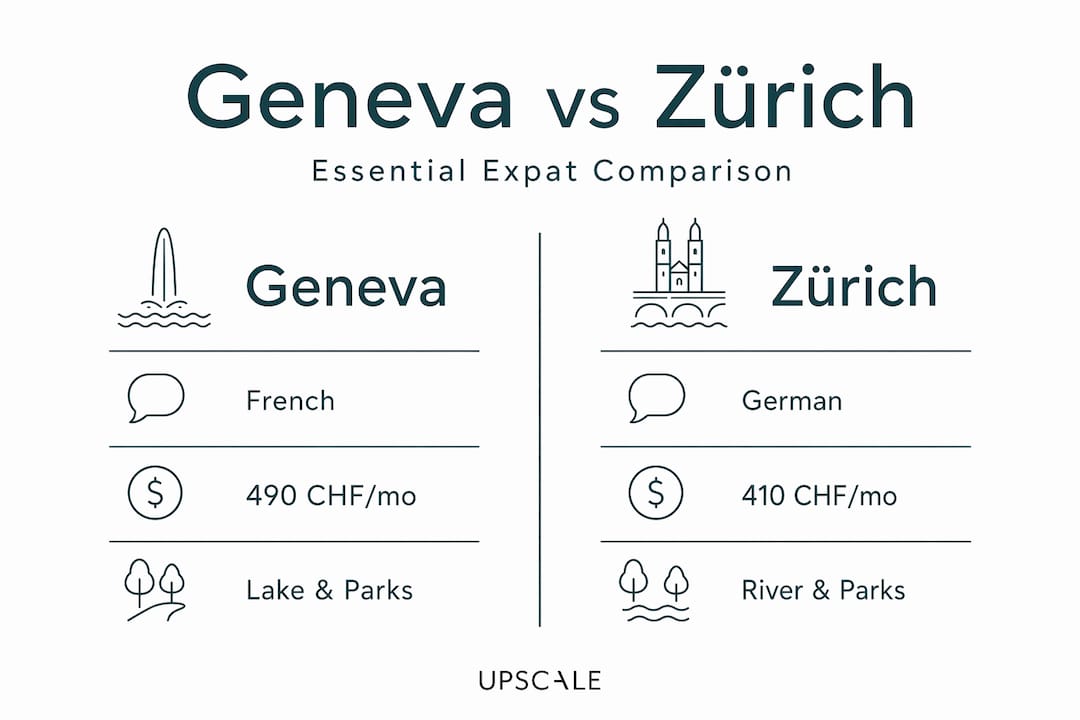
Neighborhood character shapes daily satisfaction more than most expats anticipate. Proximity to the lake and parks matters enormously for quality of life, especially if you work long hours and need outdoor space to decompress. The neighborhoods near Parc des Eaux-Vives and Champel offer green, residential environments while staying connected to the city center.
French fluency in Geneva is genuinely important outside the international bubble. Supermarkets, local services, parent-teacher meetings, building management, and social integration all happen in French. Many expats who work entirely in English still find that their quality of daily life improves significantly once they reach conversational French. Investing in language classes within your first year is less of a luxury and more of a practical necessity.
My honest take on what Geneva really offers
I’ve spent time in Geneva across different seasons and from different angles, as a visitor, a design professional working with clients in the city, and a close observer of what makes people genuinely happy after relocating there. And I’ll tell you something that most city guides skip entirely.
Geneva’s international reputation is both its greatest asset and its biggest distraction. People arrive expecting a city that feels like a UN summit, all glass buildings and diplomatic tension. What they find instead is a city whose identity shifts block by block, from the gritty charm of Pâquis to the polished quiet of Champel to the artisan energy of Carouge.
The travelers who love Geneva most are the ones who stop treating the Jet d’Eau as a finish line and start walking further. The expats who thrive are the ones who accept early that neighborhood-level social atmosphere matters more than commute time to their office.
The new UN Portail des Nations is genuinely exciting to me, not just as a tourism development but as a statement. It signals that Geneva wants visitors to understand its diplomatic identity rather than just photograph the Palais des Nations from outside the gates. That shift in how the city presents itself feels meaningful. It reflects a city growing into a more open, more accessible version of itself.
My honest advice? Give yourself at least three days if you’re visiting. Give yourself at least six months before judging it if you’re relocating. Geneva rewards patience.
Designing your Geneva home the right way
If you’re relocating to Geneva or finally moving into the apartment you’ve been planning around, this is where things get exciting for your living space. Setting up a home in a new city is one of those moments where getting the interior right makes everything feel more settled and more you. Upscale offers professional Geneva interior design services tailored to the specific character of Swiss apartments and homes, from space planning and material selection to full project management. Whether you’re drawn to a warm Scandinavian feel or something more polished and classic, Upscale’s designers bring real local knowledge to every project. You can also explore how to budget for bespoke interior design in Switzerland before your first consultation. Start with an interior design consultation and see how good your Geneva home can feel.
FAQ
What is Geneva best known for?
Geneva is best known as a global hub for international diplomacy, housing the European headquarters of the United Nations, the World Health Organization, and the International Red Cross. It’s also celebrated for its lakefront beauty, Old Town history, and luxury watchmaking heritage.
Is the Geneva Transport Card free for tourists?
Yes. Guests staying at hotels, hostels, or campsites in Geneva automatically receive the Geneva Transport Card, which provides free unlimited use of trams, buses, trains in zone 10, and river shuttles for the duration of their stay.
When does the new UN visitor center open?
The UN Portail des Nations visitor center is scheduled to open in May 2026. It will serve as the main entry point for Palais des Nations tours and is expected to welcome around 180,000 visitors per year.
Is Geneva expensive for expats?
Yes, Geneva is one of Switzerland’s most expensive cities for residents. Health insurance premiums average around CHF 490 per month, and housing costs are high, particularly in lakeside neighborhoods. Budgeting carefully before relocating is strongly recommended.
Do you need to speak French to live in Geneva?
Outside the international professional environment, French is the language of everyday life in Geneva. While English is widely spoken in work settings, learning French significantly improves social integration, access to local services, and overall quality of life.
Recommended
- Geneva Interior Design | Swiss Interior Designers – Upscale
- Upscale Interiors Designers | Carina
- Navigate the interior design tender process in Switzerland
- How to set a bespoke interior design budget in Switzerland