Human centric lighting is a dynamic approach that supports daily rhythms and wellbeing by delivering the proper light at the proper time, measured as melanopic EDI at the eye. The CIE recommends at least 250 lx during the day, no more than 10 lx in the three hours before bed and no more than 1 lx while sleeping. We walk you through the design steps and commissioning checks that follow.
TL;DR:
- Use these targets: at least 250 lx melanopic EDI by day, at most 10 lx in the three hours before bed, and 1 lx during sleep.
- Measure vertical melanopic EDI at eye height where occupants look; desk lux and color temperature alone cannot establish biological stimulus.
- Treat home lighting as supportive design, not treatment: evidence is limited and conflicting, while scarce interventions, wrist sensors, and varied outcomes weaken conclusions.
- Combine daylight with electric lighting, control glare, and request predictions at eye height, control schedules, and measurements after installation from the lighting designer.
Upscale Interiors
Plan Lighting Around Your Space
Upscale Interiors provides tailored interior design and architecture for Swiss homes and offices, including space planning and project management.
How does human centric lighting work on the body?
Your eyes do two jobs with light. Cones and rods help you see; a third group of cells, the intrinsically photosensitive retinal ganglion cells (ipRGCs), uses the pigment melanopsin to tell your body clock what time it is. That second job is what human centric lighting is built around.
The CIE defines melanopic EDI as the equivalent daylight (D65) illuminance that describes the stimulus reaching those cells. It is not the same as the lux reading on your desk.
- Spectrum, timing, intensity and duration all shape the biological effect, so no single number tells the whole story.
- Vertical illuminance at the eye matters more for the body clock than the horizontal light falling on a table.
- Melanopic and photopic values differ, so a room can look bright and still deliver little biological stimulus.
The CIE stresses that no one-size-fits-all setting exists, and recommends adjusting intensity and spectrum across the 24-hour cycle instead.
What does the evidence say, and where does it stop?
Light clearly affects sleep and mood, but the research is more cautious than the marketing. A systematic review points to a positive association between chronic exposure to artificial light at night and depressive symptoms. Another systematic review on mental disorders found moderate evidence for the same link, while noting that confounding factors may colour the results.
Home settings are murkier. Researchers caution that evidence for personal light exposure benefits in habitual home settings is limited and sometimes conflicting. A review of lighting in the home found suggestive but heterogeneous evidence.
- Intervention studies are scarce, so cause and effect are hard to pin down.
- Wrist-worn light sensors and varied outcome measures weaken many conclusions.
- A review of personal daily light exposure rated overall study quality as low.
So we design for what is well grounded: strong daytime light to support your body clock, and calmer, lower-blue light in the evening. We never promise a clinical cure.
Which melanopic EDI targets should you aim for?
The consensus numbers come from the CIE's 2024 position statement, which builds on Manchester II guidance. Here is the daily pattern it recommends:
At least 250 lx melanopic EDI at the eye by day, no more than 10 lx in the three hours before bed, and no more than 1 lx while sleeping. These are the figures to put in a brief.

Why not simply quote colour temperature? Because CCT describes how light looks, not how strongly it stimulates ipRGCs. Two lamps with the same CCT can deliver very different melanopic doses.
Measurement matters too. Practitioners note that effective design focuses on melanopic EDI at the eye and relies on measurement, a daylight strategy and specialist input, not tunable-white fixtures alone. Measure at eye height, facing where you actually look, and balance daylight contribution against glare.
How do you apply these principles at home?
Start with daylight, then layer electric light around it. Here is the order we work in:
- Maximise daylight while you are awake. Position desks, breakfast tables and reading chairs near windows, and use pale, reflective finishes to push light deeper into the room.
- Layer ambient, task and accent light. Place fixtures so some light reaches the eye from the side or front, not only the work surface.
- Shift the evening toward warm, dim light. Use dimmers, lower-blue sources and low-level lamps instead of a single bright ceiling light.
- Soften the source. Indirect lighting bounces light off ceilings and walls, which makes evenings feel calmer and cuts glare.
- Protect the bedroom. Fit blackout window treatments and keep night lighting sparing and low.
Pro Tip: Keep curtains open in the daytime and aim for a dark bedroom at night; a review of home lighting backs these simple measures even where wider evidence is still developing.
How does human centric lighting work in offices?
Workplaces have the most to gain, because people spend long hours indoors. Swiss workplace guidance under ArGV 3 asks for adequate natural or artificial light, recommends daylight in workrooms, and advocates daylight-like artificial lighting where there are no windows.
- A Swiss field study of two open-plan offices found that automated blinds improved daylight penetration and melanopic exposure compared with manual blinds.
- Automated blinds with manual override balance comfort and exposure.
- Retrofits can add circadian-capable controls, upgrade task lighting and validate the result by measurement.
What do controls and technology need to deliver?
Three terms get mixed up. Dimming changes brightness only. Tunable white shifts colour temperature. Spectral control adjusts the actual spectral mix, which is what changes melanopic stimulus most directly.
- Sensors, schedules and easy user overrides keep the system comfortable. People abandon lighting that fights them.
- Daylight plus electric light works best, because daylight supplies the strong daytime dose.
- Ask suppliers whether they can model vertical melanopic EDI, provide control schedules and protect visual quality.
How do you brief and commission a project?
Use this checklist when you speak to a designer or lighting specialist:
- Define target melanopic EDI for each time of day.
- Ask for vertical illuminance predictions at eye height.
- Include a daylight strategy and glare control.
- Request control diagrams and a user interface mock-up.
- Agree a measurement plan for after installation.
Bring in a specialist when daylight, glare and tunable control all interact. For a retrofit, phase the work: daylight and bedroom darkness first, controls later. In a full rebuild, plan windows and circuits from day one.
Where do these ideas come from?
Light and health were linked long before LEDs. Earlier thinkers argued for sun-filled sanatoria and daylight in workplaces, and the idea that light affects mood sits behind today's light therapy for seasonal depression.
The decisive shift came with the discovery of ipRGCs. Once researchers showed that the eye has a dedicated route to the body clock, lighting stopped being only about seeing. Trade literature now describes HCL as systems that change light colour along a time-of-day curve, with daylight at the centre and careful artificial light around it.
The idea has matured since. The CIE's 2024 third edition brought in Manchester II guidance on day, evening and night exposure, shifting the conversation from colour temperature towards measured biological dose. That is the logic we follow in every project.
How do light spectra and colour temperatures affect mood?
Short-wavelength, blue-rich light stimulates melanopsin most strongly. High blue content in the evening can inhibit melatonin secretion, which is why Swiss public health advice includes reducing screen brightness and using blue-light filters at night. The same review notes that melatonin recovers within about 15 minutes once light stops, though chronic disruption may have cumulative effects.
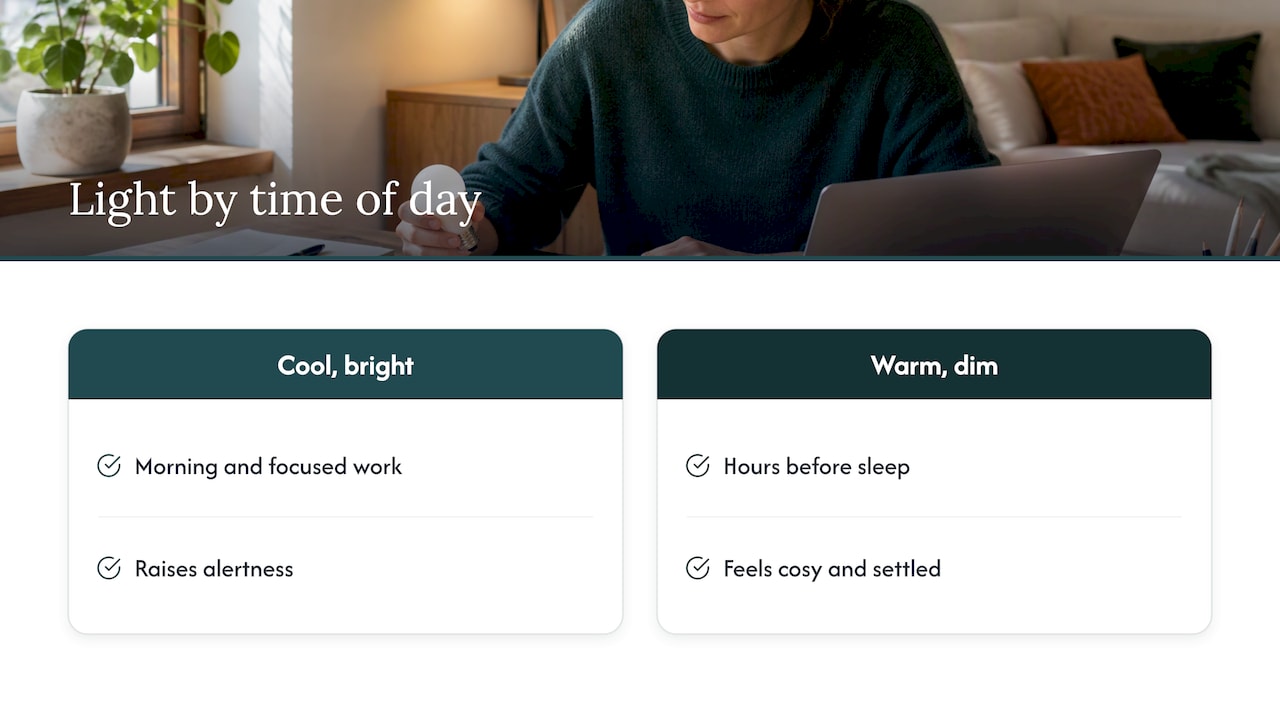
In practice, cool, bright light suits morning and focused work, because it raises alertness. Warm, dim light suits the hours before sleep. Mood follows partly: harsh light can feel clinical and tiring, while warm layered light feels cosy and settled.
Remember the CIE point that effects depend on level and spectrum together. A dim cool lamp and a bright warm one can behave unexpectedly, so we check the actual melanopic output instead of trusting a label. Daylight is the best reference, because it changes colour and intensity naturally across the day.
What does a luxury project look like in practice?
We do not publish invented client results, so here is how our process reads on typical high-end briefs. In an alpine chalet, large south-facing glazing carries the daylight dose, while warm dimmable layers take over after sunset and blackout treatments protect the bedrooms. In a lakeside apartment, indirect cove lighting gives evening glow without glare on reflective surfaces.
In offices and commercial spaces, we start with the daylight and blind strategy. The Swiss office study above shows why: automated blinds with manual override helped balance exposure and comfort. For wellness-led builds, natural light and quiet-room strategies show how small spaces can carry the same principles.
Across all of these, three habits repeat: set targets before choosing fixtures, test scenes with the client in the finished room, and adjust schedules after living with them for a few weeks. We would rather tune a working scheme than promise a perfect one on paper.
How can human centric lighting stay energy efficient?
Good HCL should not mean more light everywhere. Practitioners warn against merely over-lighting spaces to meet energy or visual standards. The goal is the right dose at the eye, not maximum output.
Daylight is the most efficient lever, since it is free and delivers high melanopic stimulus. Glazing, light-coloured finishes and well-placed work areas reduce the load on electric lighting. Sensors and schedules then dim or switch fixtures when daylight is enough.
The CIE itself flags that achieving recommended vertical melanopic EDI without glare and within energy constraints is a core design challenge. Delivering light towards the eye, rather than flooding rooms, helps. So does using low levels in the evening, which saves energy while supporting sleep. Efficient LED sources, controls that actually get used, and fixtures that last all add to a sustainable scheme.
Which lighting technologies and fixtures suit human centric lighting?
Most schemes combine a few fixture types, each with a clear job:
- Tunable-white LED luminaires shift colour temperature through the day and suit ceilings, cove lines and pendants.
- Spectrally controllable fixtures adjust the spectral mix and give finer control over melanopic output.
- Indirect and cove lighting lights surfaces rather than eyes, so evenings stay soft; decorative coving with LED can hide the source neatly.
- Task and floor lamps give local, dimmable light for reading and detailed work.
- Controls, sensors and blinds tie it together by following schedules and daylight.
Trade sources describe HCL as time-based changes in intensity and spectrum, combined with daylight maximisation and high-quality artificial lighting. A fixture on its own proves nothing; ask what the whole system delivers at the eye.
Our view: measure the dose, then make it beautiful
Too much HCL talk starts with the gadget. We start with the target. In bespoke work, we set a melanopic goal for morning, evening and night, then let material, colour and fixture choices serve it. Warm timber and soft plaster take evening light beautifully, while glossy surfaces can bounce glare back at you. We stage scenes with clients in the finished room and adjust before handover. Questions about your own project are always welcome.
How can we help you plan lighting for your home or office?
We shape a tailored lighting strategy as part of your interior design, with 3D visualisations and project coordination so lighting, materials and furniture work together.
- Book a consultation for 490 CHF, or compare our Single Area and Full Home packages.
- Explore everything on our interior design packages page and take the first step today.
This article is general information, not a substitute for advice from a qualified doctor. Consult a qualified healthcare professional about your own circumstances before acting on anything here.
FAQ
What is human-centric lighting?
Human-centric lighting is lighting designed to support your body clock and wellbeing, not only your ability to see. It changes intensity and spectrum through the day, giving strong light by day and calm, low light in the evening, as the CIE recommends.
What are the psychological effects of lighting?
Light influences alertness, mood and sleep through the body clock. Research links chronic light at night with depressive symptoms, though confounding factors may influence the findings and more robust evidence is needed.
Is tunable white lighting enough for human centric lighting?
No. Practitioners say effective design focuses on melanopic EDI at the eye and needs a daylight strategy and measurement, not just tunable fixtures.
Does human centric lighting prove health benefits at home?
Not yet conclusively. Researchers caution that evidence in habitual home settings is limited and sometimes conflicting, so we treat it as supportive design, not treatment.
Sources