The right ceiling track depends on three things: the weight and heading of your curtains, the number of layers you want (one run or two), and what your ceiling can safely hold. Get those three right and the curtain looks as if it grows out of the architecture. Get them wrong and you'll be fighting sagging, stuck gliders or a hem that hovers at the wrong height.
We design homes across Switzerland, and a good curtain solution is one of those quiet details that makes a room feel finished. Whether you live in a high-ceilinged apartment in Zürich or a newly built home on the lake, this guide walks you through the choice step by step: track type, measuring, fixings, gliders and curtain length.
Upscale Interiors
Bring Your Room Design Together
Explore bespoke residential interior design and interior architecture for tailored spaces across Switzerland and Europe.
TL;DR
- Choose the track by curtain weight and layers: metal for heavy fabrics, a double run if you want sheers plus a main curtain.
- Extend the track beyond the window on each side (at least 15 cm) so the curtain stacks back clear of the glass.
- Match the fixing to your ceiling (concrete, plasterboard or timber) and use enough brackets: 2, 3 or 4 depending on track length.
- Measure curtain length from the underside of the track or gliders, at three points, and decide on your hem style before you order.
- Not sure? A short design consultation saves expensive mistakes, especially with floor-to-ceiling glazing.
Why a ceiling track is worth considering
A ceiling track lets the fabric take centre stage. It sits discreetly in the room, and the curtain can run from ceiling to floor without a visible rod or bracket interrupting the line. Swiss manufacturer Hamotec describes the two-run ceiling track as the preferred solution in modern interior architecture for floor-to-ceiling window fronts, because textiles seem to flow straight out of the ceiling and the technical mounting almost disappears.
Ceiling mounting also solves practical problems. Swiss track specialist MHZ points out that ceiling tracks suit heavy curtains and room dividers, and because they are screwed to the ceiling, they work in awkward places such as high windows or under sloped ceilings (Dachschrägen). If you've ever tried to hang a rod under a sloping roof, you'll know how much of a game-changer that is.
A wall-mounted track still has its place: it can be the better choice where the ceiling can't provide a secure fixing or where you need more projection from the wall. We'll flag that in the fixings section below.
Types of ceiling track and what they're made of
Material: metal for weight, plastic for light fabrics
Tracks come in aluminium, steel and plastic. Houzz notes that metal tends to be stronger than plastic, which makes it the more appropriate choice for heavy curtains, and that metal tracks are also more likely to come with corded options for opening tall drapes with a pull of a string. If your curtains are lined, interlined or made of dense velvet, go for an aluminium or steel profile and don't look back.
Single run, double run or more
A single run carries one layer. A double run carries two, typically a sheer and a main curtain, or a day curtain and a blackout. Hamotec notes that two-run systems let you create different light moods in parallel and, with sound-absorbing fabrics, improve the acoustics of a room. That's a real bonus in open-plan living spaces with hard floors.
For classic or layered bedrooms, Goelst recommends a double or triple channel track for operational flexibility. If you can picture yourself wanting sheer curtains by day and blackout at night, plan a second run now. Adding it later usually means taking everything down.
Surface-mounted or recessed
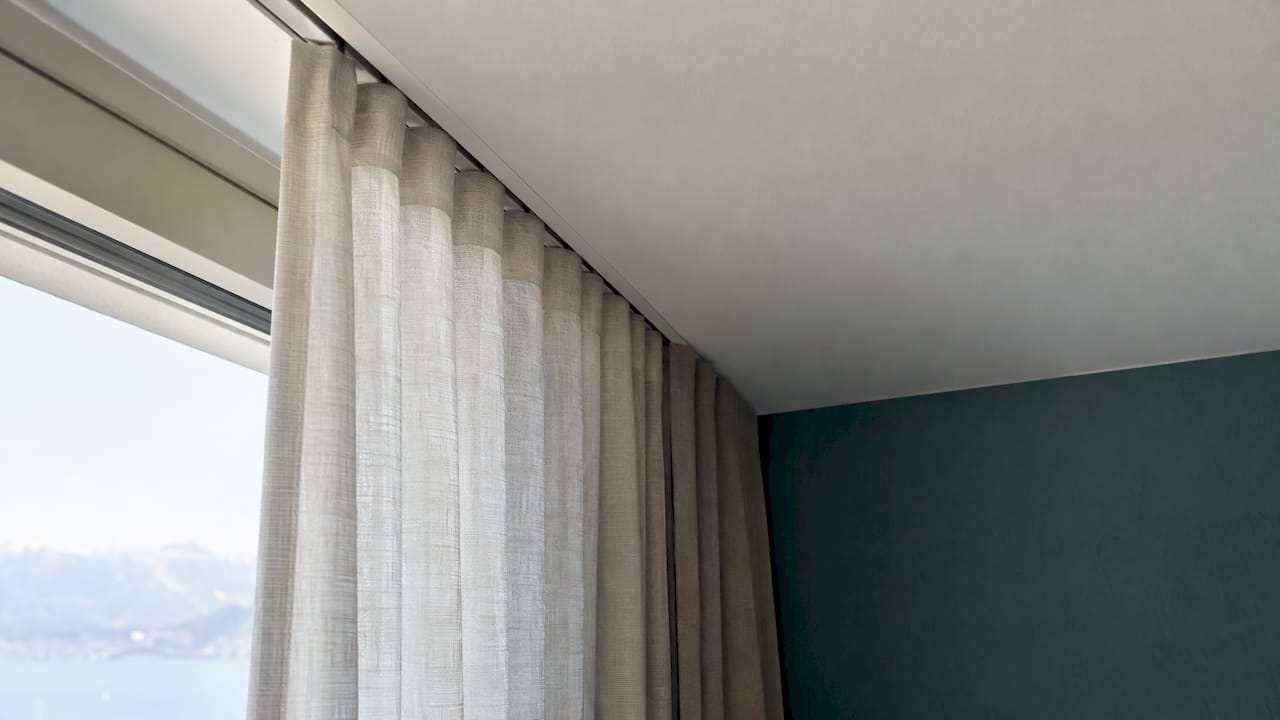
A surface-mounted track is screwed to the ceiling and is the simplest option. A recessed track is built into a slot in the ceiling structure. Silent Gliss explains that with recess fitting the curtains appear to hang from the ceiling itself. Goelst suggests this approach for contemporary or minimalist rooms, where the curtain should look as though it emerges from the architecture. A recess has to be planned with whoever is doing your ceiling, so it's a decision for the renovation stage, not the week before the curtains arrive.
Corded, hand-drawn or motorised
For very tall windows, a corded track lets you open and close curtains without reaching. The same Houzz article mentions corded options as an advantage of metal tracks. If you're building or renovating, it's also the moment to ask your electrician about a power point at the window head in case you'd like motorisation later.
Match the track to the curtain
Two curtains of the same width can need completely different tracks. Vorhangschweiz lists the key selection criteria as window shape and size, the number of runs and the curtain type. For instance, if you want a curtain that glides silently, you'll need a track with an internal runner.
Here is a quick way to think about it:
The heading changes the space you need
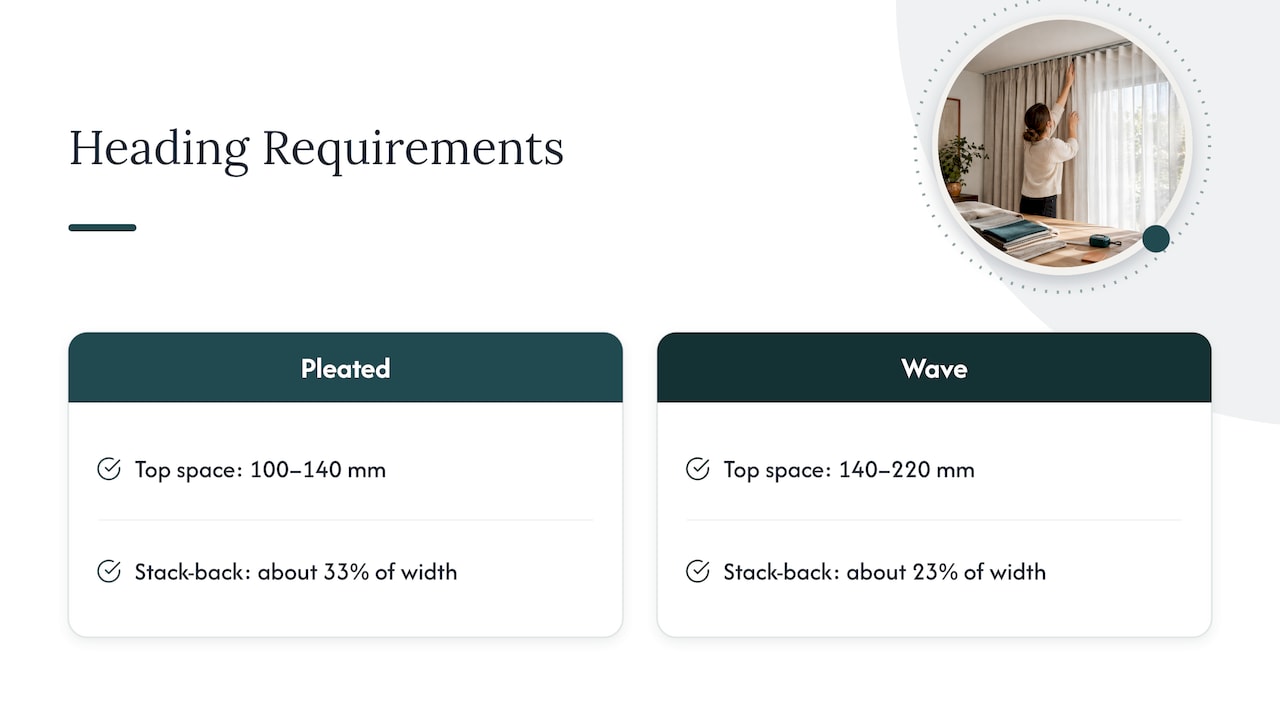
The heading (how the top of the curtain is gathered) affects both the look and the space above the window. Silent Gliss gives guide values: pleated headings need 100 to 140 mm of space at the top, while wave headings need 140 to 220 mm per system. The same guide says pleated curtains stack back into around 33% of the overall curtain width, wave curtains into around 23%. So if you have a narrow wall beside the window, a wave heading will leave you more glass visible when the curtains are open.
For rooms with limited ceiling height, Goelst prefers a ripple-fold or wave heading over a pencil pleat because it creates a vertical rhythm that reads as calm and elongated.
Measuring the track length
This is where most projects go wrong, and it's easy to avoid. Work in this order: mounting location, track width, heading, fabric width, then length.
How far beyond the window?
The track must be wider than the window, otherwise the open curtain covers the glass. IKEA's guidance for its VIDGA system says to add at least 15 cm on each side of the window for curtains, and at least 60 cm per side for sliding panels. Vorhangschweiz also suggests extending the track 15 to 20 cm beyond the window on each side for full coverage. If you have lots of fabric, or a thick heading, go towards the upper end.
How wide should the fabric be?
IKEA Austria gives a simple rule: for a simple pleat, use 1.5 to 2 times the track length in fabric, and 2 to 2.5 times for a double pleat. Bruno Wickart's guidance is similar, advising curtains two to two-and-a-half times as wide as the window front. Fuller curtains look richer and more expensive, so don't skimp here.
Measure like a professional
Switzerland uses the metric system, so work in centimetres and millimetres. And be precise: a Swiss curtain specialist notes that a deviation of just 0.6 cm can change how curtains hang to the floor. Measure height at three points (left, middle, right), because floors and ceilings are often not perfectly parallel, especially in older buildings. Use the shortest measurement for the finished length.
Fixings and brackets: getting it to stay up
A ceiling track fails at the fixing, not at the track. First, find out what's above your head.
- Solid concrete: common in many Swiss apartment buildings. For fabric track systems, Melfabco's installation guide specifies M8 or M10 torque-controlled expansion anchors in concrete of at least 25 MPa.
- Hollow block or aerated concrete: the same guide says to use M8 resin anchors and never expansion anchors.
- Timber joists: structural screws of suitable length that bite into the joist itself, not just the plasterboard.
- Suspended or plasterboard ceilings: find the joists or add a timber batten before you fix anything. If you can't find a solid fixing point, a wall-mounted track may be the better answer.
How many brackets? IKEA Austria's rule of thumb is 2 brackets up to 140 cm, 3 for 140 to 280 cm, and 4 beyond 280 cm. For heavy curtains, Houzz advises you to double-check how much weight the track can support before buying, and TrackFit recommends a robust aluminium profile with closer bracket spacing and secure structural fixings. For complicated window arrangements, a professional installer can be worth the cost.
Gliders: how many and which type
Gliders are small, but they decide whether your curtain moves smoothly. Two questions matter: which size, and how many.
Size. It depends on the slot width of the track. Vorhangbox explains that a 6.2 to 6.6 mm slot takes a Maxi glider, while 3.6 to 4.0 mm needs a Mini glider. Check the track's data sheet before ordering curtains with ready-made tape.
Number. As a rule of thumb, one glider per pleat, or roughly one per 10 cm of track, which gives about 24 gliders for a 240 cm track, according to Interdeco. More isn't better: too many gliders can block each other. Remember that the pleat style changes the count, so your curtain maker can give you the exact number for your heading.
Working out the curtain length
With a ceiling track, you measure from the underside of the track (or the bottom of the glider, depending on the heading system) down to your end point. Vorhangbox's measuring guide gives clear allowances:
- Hovering just above the floor: measure to the floor and subtract 2 cm, so the curtain hangs 1 to 2 cm above it.
- Touching the floor: subtract 1 cm.
- Pooling on the floor: add 5 to 15 cm.
Combining day curtains with night curtains? Make the day curtains about 0.5 cm shorter so they don't peek out at the bottom. Always confirm where your supplier measures from, since the reference point can vary by system. If in doubt, a centimetre too long is fixable; too short is not.
Floor, sill or pooling?
Floor-length curtains are among the most common choices and are easy to look after. IKEA's guidance adds that sill-length curtains suit windows with furniture such as a desk or sofa right below, while puddled curtains add texture but need more upkeep and collect dust. With a ceiling track and tall ceilings, floor-length almost always looks best: it makes the room feel taller.
One detail people forget is the floor itself. Thick rugs, carpet or a threshold strip near the window change how much clearance you need. If you're finishing a floor at the same time, it's worth reading the role of trims in home decor so the transition between flooring types is sorted before your curtains are cut.
Coordinating track, fabric and room style
Think of the track as part of the architecture and the fabric as part of the furniture. Some pairings we like:
- Modern and minimal: a recessed or slim white track, linen or cotton in a tone-on-tone palette, wave heading. Goelst recommends exactly this kind of combination for contemporary rooms.
- Scandinavian: a white ceiling track that disappears, light natural fabrics, floor-length hang to keep lines calm.
- Classic or layered: a double track with sheers behind a heavier drape, richer colours, a fuller heading.
- Modern glam: a floor-to-ceiling velvet or silk-look curtain on a robust metal track, with a slight break at the floor.
Ceiling tracks are also brilliant for zoning. If you're curious about using fabric to divide a room, our article on room divider hacks shows how much you can change a space without renovating.
Our perspective
We see the same pattern again and again in homes around Zürich and across Switzerland: the curtain is chosen last, after the sofa, the lighting and the flooring, and by then the ceiling has been painted and the options have shrunk. A recessed track needs to be agreed with the builder, a second run needs space in the ceiling, and a hem that touches the floor needs the final floor height.
That's why we plan curtains together with the rest of the room: ceiling details, lighting, furniture, materials and fabrics, all in one concept. With our architecture and interior design background, we can talk to your builder in their language, draw the technical details and coordinate the installation, so the curtain looks like it was always meant to be there.
Our advice? Decide on the track before the ceiling is finished, choose the fabric before you finalise the length, and treat the curtain as part of the architecture, not an afterthought.
Giorgia D'Amico
Need help planning your curtains?
If you're facing tall glazing, a sloped ceiling or a renovation where the track needs to be built in, a professional eye can save you a lot of trouble. Our Consultation costs CHF 490 and gives you personal guidance on your space, online or in person. If you'd like us to design the whole room, including curtains, lighting and furniture, take a look at our Single Area and Full Home packages, starting at CHF 970 for a single area. We'd love to help you make it feel just wow.
FAQ
How far should a ceiling track extend beyond the window?
At least 15 cm on each side is the common guideline for curtains, and up to 20 cm gives fuller coverage. That way the curtain stacks back beside the window instead of covering the glass. Wider, heavier headings may need more.
How many gliders do I need per curtain?
A good rule of thumb is one glider per pleat, or about one per 10 cm of track, so roughly 24 for a 240 cm track. The exact number depends on your heading, so check with whoever makes the curtain. Too many can block each other.
Should the curtain hang above or below the window sill?
With a ceiling track, floor-length usually looks most elegant and makes the ceiling feel higher. Sill-length is practical if there is a desk, radiator or sofa below the window. Avoid in-between lengths, which tend to look like a mistake.
How do I determine curtain length with a ceiling track?
Measure from the underside of the track or glider to the floor at three points and use the shortest value. Then subtract about 2 cm for a curtain that hovers just above the floor, or 1 cm if it should touch. Confirm the measuring reference with your supplier.
When is it worth asking an interior designer?
When the track needs to be built into the ceiling, when you have sloped ceilings or floor-to-ceiling glazing, or when you want curtains to match the lighting and furniture. Early advice, ideally before the ceiling is finished, avoids costly changes later.
Sources
- Hamotec: ceiling curtain track, two-run
- MHZ: Vorhangschienen nach Mass
- Houzz: ceiling-mounted curtain tracks
- Goelst: ceiling curtain tracks for bedrooms
- Silent Gliss: Curtain Planning Guide
- Vorhangschweiz: installing curtain tracks
- Vorhangschweiz: measuring guide
- IKEA Switzerland: VIDGA assembly guide
- IKEA Austria: measuring windows for curtains
- Bruno Wickart: selecting and combining curtains
- Vorhangnachmass: checklist for measuring windows
- Melfabco: wall and ceiling mounting guide
- Vorhangbox: which gliders do I need
- Vorhangbox: measuring instructions
- Interdeco: gliders per metre
- IKEA Switzerland: choosing curtain lengths
- The role of trims in home decor
Recommended