.svg)

Selecting the right designer feels like the defining challenge of any luxury interior project in Switzerland. But seasoned property developers and discerning homeowners quickly discover that the real complexity lies one step earlier: navigating a structured, compliance-driven tender process that determines who gets to bring your vision to life. Get this stage right, and every subsequent decision flows with clarity and confidence. Miss it, and even the most talented designer cannot save a project derailed by procedural missteps or misaligned expectations.
Table of Contents
- Understanding the interior design tender process in Switzerland
- Key steps of the interior design tender process
- Open procedures vs. negotiated tenders: Choosing the right fit
- Best practices and pitfalls for Swiss luxury tendering
- The reality most luxury clients miss about Swiss tenders
- Ready to simplify your luxury tender journey?
- Frequently asked questions
Key Takeaways
| Point | Details |
|---|---|
| Regulations drive process | Swiss SIA standards ensure transparency and fairness for all high-value interior design tenders. |
| Thorough prep is vital | Over 90 percent complete drawings and specifications are needed to attract elite bidders and yield accurate offers. |
| Method selection is key | Choose open, direct, or negotiated tender routes based on the project’s scale and bespoke needs. |
| Quality over cost | Swiss luxury tenders legally allow and often require selection based on quality instead of just price. |
| Expert support pays off | Consulting experienced Swiss interior designers can help avoid pitfalls and deliver standout results. |
Understanding the interior design tender process in Switzerland
Let’s clarify what the tender process actually entails and the Swiss rules that shape these high-end projects.
An interior design tender is a formal procurement procedure in which a client invites qualified designers, contractors, or suppliers to submit proposals for a defined scope of work. In Switzerland, this process is far from informal. It operates within a structured regulatory environment that governs everything from how bids are published to how they are evaluated. For luxury residential and commercial projects, understanding this environment is not optional. It is the foundation on which every successful bespoke project is built.
The Swiss regulatory framework centers on the SIA (Schweizerischer Ingenieur- und Architektenverein) standards. SIA phases 31 through 53 cover architecture, furniture, and interior-related works, using open procedures for EU-wide procurement or direct awards at the national level. These phases map the full project lifecycle, from preliminary studies through execution, and tenders are typically issued at specific phase transitions. Knowing where your project sits within these phases tells you exactly when and how to launch a tender.
SIA 142 governs design competitions and interior design service procurement, emphasizing transparency, equal treatment of all bidders, and competent evaluation panels. Revised versions of SIA 142 actively promote open procedures and hybrid methods that blend competition with negotiation. This is not bureaucratic red tape. It is a framework designed to protect your investment and ensure the best talent rises to the top.
“Transparency and equal treatment are not just regulatory ideals under SIA 142. They are the practical mechanisms that prevent costly disputes and ensure the most qualified team earns the commission.”
The main types of tenders you will encounter in Switzerland include:
- Open procedure (offenes Verfahren): Published publicly, inviting any qualified firm to submit a proposal. Typically required above certain contract value thresholds.
- Selective procedure: A two-stage process where candidates first qualify, then a shortlist submits full proposals.
- Negotiated tender: A private process where the client invites specific firms to negotiate terms, common in luxury residential contexts.
- Direct award (Direktvergabe): A single firm is selected without competition, typically reserved for smaller scopes or highly specialized requirements.
For luxury residential projects in Zurich and beyond, understanding which procedure applies to your project is the first critical decision. The choice shapes your timeline, your documentation requirements, and ultimately the quality of talent you attract.
Key steps of the interior design tender process

With the context set, here’s a high-level walkthrough of how the Swiss luxury interior design tender process unfolds.
The process is sequential, but each stage demands careful attention. Rushing through early steps to reach the “exciting” design phase is one of the most common and costly mistakes luxury clients make. Here is how the journey typically unfolds:
- Project scoping: Define the full scope of work, including spatial areas, design style, FF&E (furniture, fixtures, and equipment) requirements, and any specialized technical needs. The more precise your brief, the more accurate and comparable the bids you receive.
- SIA phase alignment: Determine where your project sits within the SIA phases. Tenders for interior design services are most commonly integrated into SIA Phase 41 after the design development phases are complete, ensuring bidders have enough information to price accurately.
- Documentation preparation: Compile all technical drawings, specifications, material schedules, and site reports. This is where most projects stumble.
- Publishing the tender: Issue the tender through appropriate channels, whether a public platform or a private invitation list, depending on your chosen procedure.
- Bid collection and clarification: Receive proposals, manage bidder queries, and issue clarifications consistently to all parties.
- Bid normalization: Adjust and compare bids on an equal basis, accounting for scope differences, exclusions, and assumptions.
- Evaluation and award: Score bids against pre-defined criteria and award the contract to the selected firm.
Pro Tip: Tender packages require 90%+ complete drawings and specifications to attract serious, high-caliber bidders. Incomplete documentation does not just slow the process. It signals to top firms that the project is not ready, and the best designers will decline to bid.
| Step | Responsible party | SIA phase alignment | Common pitfall |
|---|---|---|---|
| Project scoping | Client and lead consultant | Phase 31 to 32 | Vague brief leads to incomparable bids |
| Documentation | Design team | Phase 33 to 41 | Incomplete drawings invite inflated contingencies |
| Publishing | Client or procurement advisor | Phase 41 | Wrong platform reduces qualified responses |
| Bid normalization | Quantity surveyor or PM | Phase 41 | Comparing apples to oranges inflates apparent savings |
| Evaluation and award | Client with advisors | Phase 41 to 51 | Over-weighting price undermines bespoke quality |
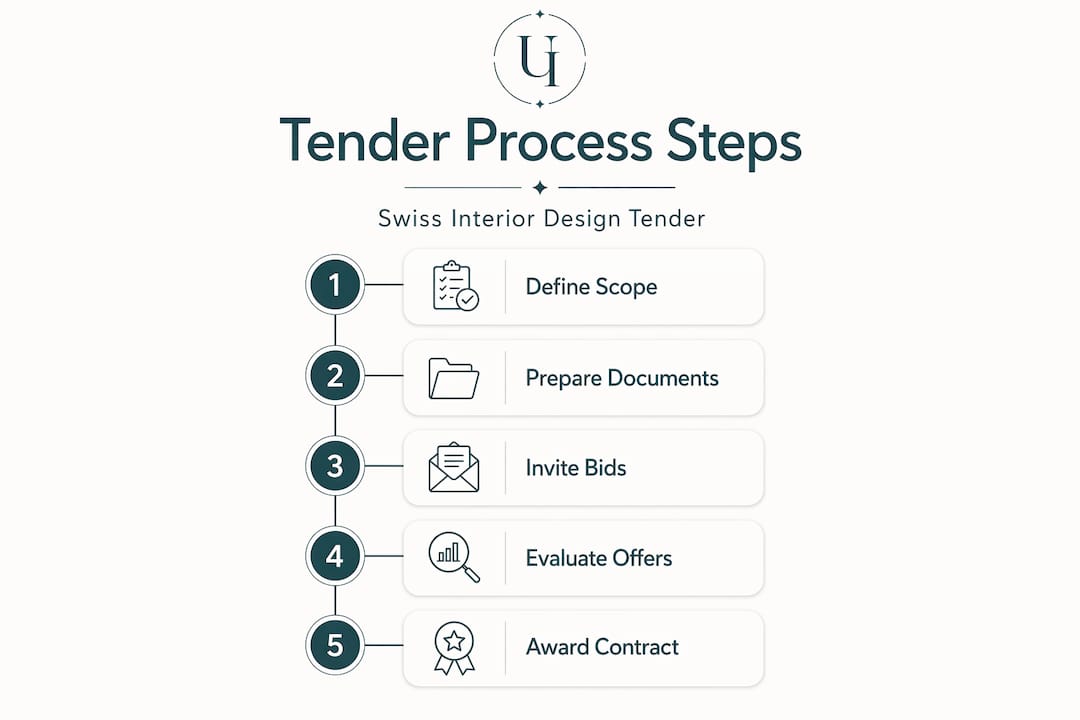
Exploring interior design inspiration during the scoping phase can also help crystallize your brief, giving bidders a clearer picture of your aesthetic direction and reducing ambiguity in proposals.
Open procedures vs. negotiated tenders: Choosing the right fit
Now, given multiple pathways to tendering, it’s vital to pick the method that matches your project’s character and goals.
The Swiss procurement landscape offers real flexibility, but that flexibility comes with responsibility. Choosing the wrong tender method can expose you to legal challenges, attract unsuitable bidders, or simply waste months of effort. For luxury and bespoke projects, the stakes are especially high because the gap between a good outcome and a great one is often determined at this decision point.
Direct awards suit smaller scopes, while open procedures apply to larger or public contracts. Luxury residential projects, however, most often favor negotiated tenders because they allow for the kind of detailed, relationship-driven dialogue that bespoke design demands. You are not buying a commodity. You are commissioning a creative partnership.
| Tender type | Best suited for | Typical project value | Key advantage | Key limitation |
|---|---|---|---|---|
| Open procedure | Large commercial or public works | Above CHF 250,000 | Maximum competition | Less flexibility for bespoke needs |
| Selective procedure | Mid to large projects with specific expertise | CHF 100,000 to 500,000 | Qualified shortlist | Longer timeline |
| Negotiated tender | Luxury residential and bespoke FF&E | Any value | Maximum flexibility | Requires strong internal brief |
| Direct award | Small scope or highly specialized work | Below CHF 100,000 | Speed and simplicity | Limited competitive pressure |
Pro Tip: For ultra-high-end interiors, price should rarely be the primary evaluation criterion. A designer whose fee is 15% higher but who has deep expertise in custom joinery, rare material sourcing, and Swiss contractor relationships will almost always deliver superior value. Weight your evaluation criteria accordingly, allocating at least 60% to quality, portfolio, and team fit.
The Klosters interior design market is a strong example of where negotiated tenders dominate. Alpine luxury properties in that region involve highly specialized contractors, rare materials, and complex logistics. An open procedure would attract firms with no relevant experience. A negotiated approach, by contrast, allows the client to engage a curated group of proven specialists from the outset.
Best practices and pitfalls for Swiss luxury tendering
Once you’ve chosen your path, avoiding classic mistakes and applying proven strategies becomes your competitive edge.
The difference between a smooth tender process and a chaotic one almost always comes down to preparation and discipline. Here are the practices that consistently separate successful luxury tenders from frustrating ones:
- Invest in documentation quality: Every hour spent perfecting drawings and specifications before the tender is issued saves multiple hours of clarification, re-pricing, and dispute resolution later.
- Use e-sourcing tools: Digital procurement platforms streamline bid management, track communications, and create an auditable record of the process. FF&E procurement specifically benefits from e-sourcing because custom items have long lead times and complex approval chains that require careful tracking.
- Establish clear evaluation criteria upfront: Define how you will score bids before you receive them. Changing criteria after bids arrive is both unfair and legally risky under SIA 142.
- Communicate consistently: Any clarification given to one bidder must be shared with all. Selective communication creates grounds for challenge and undermines trust.
- Normalize bids rigorously: Never compare raw bid totals. Adjust for scope inclusions, exclusions, and assumptions before drawing any conclusions.
The competitive bidding savings of 12 to 18% that well-run tenders can generate are only achievable when bids are properly normalized. A bid that looks 20% cheaper on the surface may exclude key deliverables that will surface as expensive variations later. This is one of the most common traps in luxury project tendering.
The most frequent pitfalls include insufficient documentation (which we have already covered), but also misaligned designer selection. Choosing a firm based on a beautiful portfolio without verifying their experience with Swiss contractor networks, local building regulations, and SIA compliance is a recipe for friction. Uliana’s approach to FF&E exemplifies how a seasoned designer integrates procurement timelines with tender stages from day one, avoiding the delays that plague projects where these workstreams run independently.
Pro Tip: Custom furniture and bespoke FF&E items often have lead times of 16 to 24 weeks. If your tender process does not account for these timelines, you risk either delaying the project or making rushed procurement decisions that compromise quality. Build FF&E lead times into your tender schedule from the very beginning. If you need focused support on a specific stage, hourly design tender support can provide targeted expertise without committing to a full-service engagement.
The reality most luxury clients miss about Swiss tenders
Beyond frameworks and checklists, here’s the inside perspective luxury project owners need to hear.
After working through dozens of high-end Swiss projects, we have observed something that no procurement manual will tell you: the clients who get the best outcomes are not necessarily the ones who follow every procedural step perfectly. They are the ones who stay deeply engaged throughout the process and who treat the tender as the beginning of a relationship, not just a selection mechanism.
Regulatory compliance is necessary. Documentation quality is critical. But the projects that truly become landmark spaces share a different quality. The owner or developer was present, curious, and willing to adapt. They asked hard questions during bid presentations. They pushed back on proposals that were technically compliant but creatively uninspired. They understood that the tender process is a filter, not a guarantee.
There is also an uncomfortable truth about relationships in the Swiss luxury market. The best designers and contractors are busy. They choose their projects. A well-structured tender with clear documentation and fair evaluation criteria signals professionalism and attracts serious talent. But so does reputation, referral, and the sense that a client is genuinely invested in the outcome. Process and relationship are not competing forces. They reinforce each other.
“The clients who get the most from their tender process are the ones who see it as a conversation starter, not a bureaucratic hurdle. The paperwork creates the conditions. The relationship determines the outcome.”
We have seen this play out repeatedly in Geneva luxury design projects, where the market is sophisticated and the talent pool is selective. A technically perfect tender issued by a disengaged client attracts technically correct responses. A well-prepared tender issued by an engaged, passionate client attracts the designer’s best thinking from the very first submission.
The lesson is simple but easy to overlook: master the process, then go beyond it. Your involvement, your clarity of vision, and your willingness to build genuine partnerships are what transform a compliant procurement exercise into a truly extraordinary interior.
Ready to simplify your luxury tender journey?
Navigating Switzerland’s interior design tender process is genuinely complex, but you do not have to figure it out alone. The right expertise makes the difference between a process that drains energy and one that builds momentum toward your vision.
Upscale Interiors brings deep knowledge of Swiss procurement standards, SIA compliance, and bespoke project management to every engagement. Whether you are at the scoping stage or ready to issue a tender, our Swiss luxury interior designers can guide you through every decision with confidence. Book a personalized project consultation to discuss your specific requirements, or explore our full range of bespoke interior solutions to find the service level that fits your project. Your vision deserves a process that matches its ambition.
Frequently asked questions
What is the main difference between open and negotiated tenders in Swiss interior design?
Open tenders invite proposals from a broad pool of firms, while negotiated tenders select a curated shortlist for tailored, private negotiation, making them the preferred choice for bespoke luxury projects where creative fit and specialist experience matter most.
How much documentation is needed for a Swiss interior design tender?
Tender packages should include over 90% complete drawings, specifications, and relevant technical documents to ensure accurate and genuinely competitive bidding from qualified firms.
Is it possible to prioritize quality over price in Swiss luxury tenders?
Yes, and for bespoke projects it is strongly recommended. Quality-focused evaluation is both permitted and encouraged within the SIA 142 framework, allowing clients to weight portfolio quality, team expertise, and project alignment above fee levels.
How much can competitive tendering save on a luxury interior project?
A well-run competitive tender can generate savings of 12 to 18% compared to uncontested procurement, provided all bids are rigorously normalized for scope and quality before comparison.