.svg)

Designing a luxury home in Switzerland is one of the most rewarding investments you can make, but it can also become one of the most expensive surprises if you enter the process without a clear financial roadmap. Many homeowners begin with a strong aesthetic vision, only to find their budget dissolving mid-project when unexpected costs surface, custom lead times stretch, or material selections shift. A well-structured, bespoke budget does not restrict your creativity. It actually protects it, giving you the freedom to make bold choices with confidence at every stage of the project.
Table of Contents
- Clarify your vision and scope
- Itemize requirements and set baseline estimates
- Build in contingency and flexibility
- Strategic execution: phasing, sourcing, and verification
- A luxury expert’s perspective: Budgeting as creative power
- Next steps: From vision to Swiss luxury interiors
- Frequently asked questions
Key Takeaways
| Point | Details |
|---|---|
| Clarify priorities early | Defining your vision and key spaces optimizes budget allocation before any spending. |
| Itemize for accuracy | Listing requirements and their costs leads to a reliable, bespoke budget for Swiss luxury interiors. |
| Always add contingency | Including a 10-20% contingency prevents costly overruns and handles uncertainties smoothly. |
| Phase and verify spending | Executing the project in phases allows for precise tracking and adjustments throughout the process. |
| Budget as creative empowerment | Strategic financial planning unlocks enduring value and beauty in your luxury home. |
Clarify your vision and scope
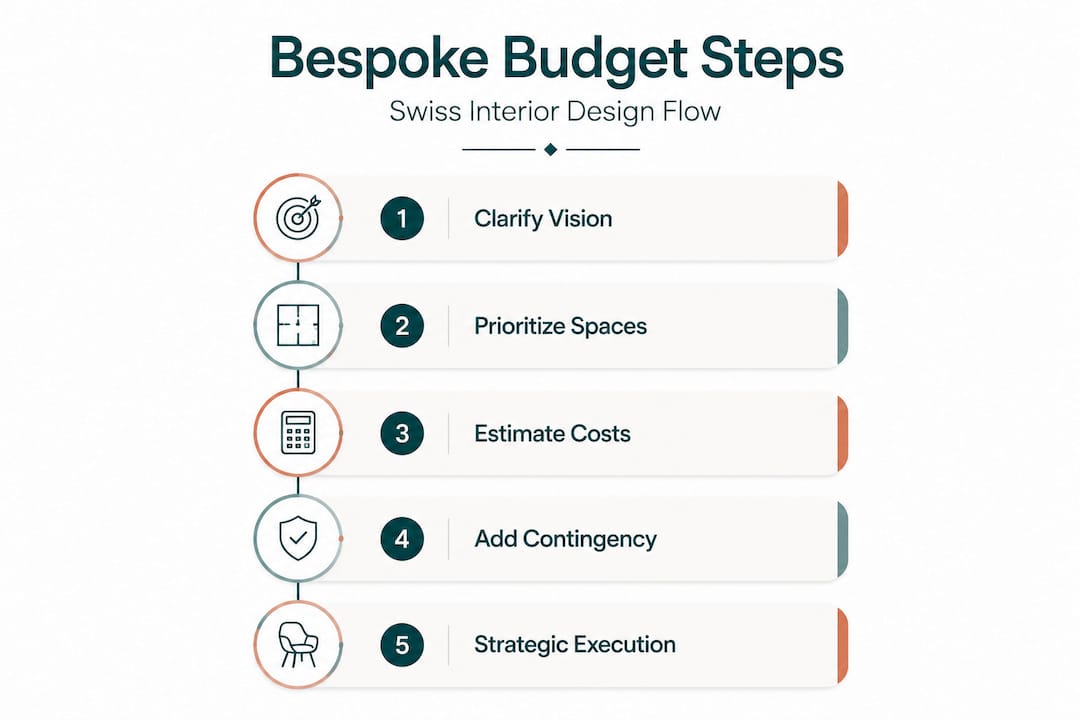
Before a single number goes on paper, you need to know exactly what you are designing and why. A vague brief like “I want something modern and luxurious” will produce vague estimates and, eventually, budget overruns. The most successful luxury interior projects in Switzerland start with a precise articulation of aesthetic goals, functional requirements, and room-by-room priorities.
Start by asking yourself these foundational questions:
- What feeling should each room create? Warmth and intimacy in the living room? Calm efficiency in the home office? Dramatic elegance in the dining room?
- Which rooms carry the most weight? The primary bedroom, main living area, and kitchen typically justify the highest investment.
- What is the balance between custom and standard pieces? Custom joinery, bespoke upholstery, and made-to-measure furniture command premium prices but deliver unmatched fit and longevity.
- Are there structural or regulatory constraints? In Switzerland, renovations in older buildings or listed properties often require cantonal approvals that affect both timeline and cost.
- What is your target completion date? Phased timelines allow for staged spending and reduce financial pressure.
Finding design inspiration early is not just about aesthetics. It is a practical budgeting tool. When you can show a designer a curated mood board, they can quickly identify which elements are achievable at your price point and which will require creative substitutions.
One of the most effective strategies recommended for house renovations in Switzerland is to prioritize spaces, make early material choices, and mix custom and standard furnishings to optimize your overall budget. This approach prevents the common mistake of spending the majority of your funds on one showpiece room while neglecting the cohesion of the rest of the home.
Here is a simple comparison to illustrate how prioritization affects budget allocation:
| Room | Investment level | Rationale |
|---|---|---|
| Primary living area | High | First impression, most used space |
| Master bedroom | High | Daily comfort and personal sanctuary |
| Guest bedroom | Medium | Occasional use, quality over quantity |
| Home office | Medium to high | Functional precision matters here |
| Utility and storage | Low to medium | Functionality over aesthetics |
Using room prioritization tips to guide your allocation ensures that your highest-impact spaces receive the attention they deserve, while secondary spaces are handled efficiently. And selecting materials early in the process locks in pricing before supply chain shifts or seasonal increases affect your costs.
Itemize requirements and set baseline estimates
After clarifying your vision, it is time to translate ambitions into concrete requirements and baseline numbers. This is where many homeowners either skip ahead too quickly or become overwhelmed. The solution is a structured itemization process that breaks your project into manageable categories.
Here is a step-by-step approach to building your itemized list:
- List every major project element. Include structural work, flooring, wall treatments, lighting, window treatments, furniture, art, and accessories.
- Separate fixed costs from variable ones. Structural work and bespoke joinery have firm quotes. Decorative accessories and soft furnishings offer more flexibility.
- Research Swiss luxury benchmarks. High-end interior projects in Switzerland routinely range from CHF 1,500 to CHF 4,000 per square meter depending on finish level, custom work, and material origin.
- Account for designer fees. Full-service interior design in Switzerland typically adds 15 to 25 percent on top of procurement costs, though this often saves money through access to trade pricing and project management expertise.
- Factor in logistics and installation. Delivery of large custom furniture pieces, specialist installation for bespoke joinery, and coordination fees are frequently overlooked line items.
Pro Tip: Ask your designer for a phased cost breakdown rather than a single total figure. Seeing costs organized by phase (design development, procurement, installation) makes it far easier to review, adjust, and approve spending incrementally.
The strategy of mixing custom furniture solutions with carefully selected standard pieces is one of the smartest ways to optimize use of funds in a luxury project. A custom dining table paired with beautifully sourced standard chairs, for example, creates visual impact at a fraction of the cost of a fully bespoke dining set.
Here is a sample baseline cost table for a high-end Swiss living room renovation:
| Item | Estimated cost range (CHF) | Notes |
|---|---|---|
| Custom joinery (shelving, cabinetry) | 8,000 to 25,000 | Varies by complexity |
| Bespoke sofa and seating | 6,000 to 18,000 | Fabric and structure choices |
| Flooring (stone or hardwood) | 4,000 to 15,000 | Per room, installed |
| Lighting (fixtures and installation) | 3,000 to 10,000 | Including smart controls |
| Window treatments | 2,500 to 8,000 | Custom drapes or blinds |
| Art and accessories | 2,000 to 10,000 | Highly variable |
These figures are starting points, not ceilings. For expert designer insights on how to calibrate these numbers to your specific project, working with a seasoned professional makes a significant difference in accuracy and outcome.
Build in contingency and flexibility
Now that you have baseline estimates, it is vital to protect your investment with smart contingency strategies. In luxury interior design, the unexpected is not a rare exception. It is a near certainty. Hidden structural issues, long lead times on imported materials, regulatory requirements, and evolving client preferences all have the potential to shift your budget mid-project.
The standard recommendation for Swiss renovation projects is to allocate 10 to 20% of your total budget as a contingency reserve. For a CHF 200,000 project, that means setting aside CHF 20,000 to CHF 40,000 for unforeseen costs. This is not money you expect to spend. It is insurance that keeps your project moving without painful pauses or compromises.
Key areas where contingency funds are most commonly needed:
- Structural discoveries. Opening walls or floors during renovation often reveals issues that require immediate attention before design work can continue.
- Material substitutions. When a specified stone or fabric is discontinued or unavailable, the replacement may carry a premium.
- Regulatory compliance. Swiss building codes and cantonal regulations vary, and compliance upgrades can add unexpected costs.
- Client-driven changes. As the project takes shape, it is natural to want adjustments. Having flexibility in your budget makes these changes possible without derailing the overall plan.
- Currency and import fluctuations. Many luxury materials and furnishings are sourced from Italy, France, or Scandinavia. Exchange rate shifts can affect final costs.
“A luxury interior project without contingency is like a Swiss watch without a movement reserve. The precision is there, but the resilience is not.”
Beyond the contingency reserve, build flexibility into your line items by categorizing them as fixed, flexible, or aspirational. Fixed items are non-negotiable: structural work, core furniture, and lighting. Flexible items can be adjusted in specification or quantity. Aspirational items are the beautiful additions you will include if the budget allows. This three-tier structure gives you clear decision-making power at every stage without sacrificing the overall vision.
For ongoing cost management advice and real project examples, staying connected to professional resources throughout your project is one of the simplest ways to avoid costly surprises.
Strategic execution: phasing, sourcing, and verification
With contingency built in, focus on strategic project execution for maximum value and control. How you phase your spending, where you source your materials, and how rigorously you verify costs against estimates will determine whether your project finishes on budget or drifts beyond it.
Phasing your project is the single most powerful tool for maintaining budget control. A well-structured luxury interior project typically moves through three phases:
- Design and planning phase. All design decisions, material selections, and custom specifications are finalized before any procurement begins. Changes at this stage cost time, not money.
- Procurement and sourcing phase. Materials, furniture, and custom pieces are ordered. Payments are staged according to supplier terms, giving you financial breathing room.
- Installation and styling phase. Tradespeople, installers, and your design team bring everything together. Final costs are reconciled against estimates, and adjustments are made within the contingency budget.
Sourcing directly is another strategy that delivers measurable savings. According to luxury home furnishing data, a phased approach to furnishings combined with direct sourcing significantly reduces markups that accumulate through multiple intermediaries. When your designer has direct trade relationships with manufacturers, you benefit from both better pricing and priority access to limited production pieces.
Pro Tip: Request itemized invoices at every procurement stage. Comparing each line item against your original estimate immediately flags where costs are drifting, allowing you to make informed decisions before small variances become large problems.
Here is a comparison of sourcing approaches and their typical impact on cost:
| Sourcing method | Typical markup | Advantages | Risks |
|---|---|---|---|
| Retail purchase | 40 to 80% above trade | Immediate availability | Highest cost |
| Designer trade pricing | 15 to 30% above cost | Quality assurance, curation | Depends on designer network |
| Direct from manufacturer | Lowest markup | Best pricing, customization | Longer lead times |
| Auction or vintage | Highly variable | Unique pieces, potential savings | Condition and availability risk |
An online design strategy can also complement your in-person project management by allowing remote review of sourcing options, 3D visualizations, and cost comparisons without requiring on-site meetings at every decision point. For homeowners with complex schedules, this hybrid approach is both efficient and effective.
Working with a team that has deep Swiss interior design experience ensures that every phase is executed with the precision and attention to detail that luxury projects demand.
A luxury expert’s perspective: Budgeting as creative power
Here is the perspective that most budget guides miss entirely: a well-crafted budget is not a ceiling on your creativity. It is the structure that makes genuine creativity possible.
When you know exactly what you have to work with, you stop chasing every beautiful thing you see and start making deliberate, confident choices. The homeowners who end up with the most extraordinary interiors are rarely those with unlimited funds. They are the ones who understood their priorities clearly and invested with intention.
Swiss luxury design has always favored durable, high-quality choices over trend-driven spending. A Valais stone floor, a hand-stitched leather sofa, or a piece of bespoke joinery crafted by a local artisan will outlast three generations of fashionable furniture. When your budget is structured around longevity rather than novelty, every franc you spend builds lasting value.
The most common regret we hear from clients who managed their own budgets before coming to us is not that they spent too much. It is that they spent in the wrong places, usually front-loading on decorative items and underinvesting in the foundational elements that define how a space actually feels to live in.
Think of your budget as a strategic blueprint rather than a constraint. Allocate generously to the elements that create atmosphere: lighting, texture, proportion, and materiality. Be more economical with items that are easily replaced or updated over time. This approach, guided by designer wisdom and a clear understanding of your own priorities, produces interiors that feel both intentional and timeless.
The Swiss approach to quality is instructive here. Precision, restraint, and enduring craftsmanship are values that translate directly from watchmaking and architecture into interior design. When you budget with those values in mind, you are not just designing a beautiful home. You are creating a legacy space.
Next steps: From vision to Swiss luxury interiors
Your budget framework is now in place. The next step is connecting with the right team to bring it to life with the precision and artistry it deserves.
At Upscale Interiors, we work with discerning homeowners across Switzerland to translate clear visions and realistic budgets into spaces that exceed expectations. Whether you are beginning a full-home transformation or focusing on a single signature room, our team offers the expertise, trade connections, and project management discipline to keep your project on track and on budget. Explore our project portfolio for inspiration across a range of styles and scales. If you are ready to start, our single area design package offers a focused, efficient entry point. To speak directly with our Zurich luxury designers, book a consultation and take the first step toward your ideal Swiss interior.
Frequently asked questions
How much contingency should I plan for a Swiss luxury interior project?
A 10 to 20% contingency reserve is recommended to cover unforeseen structural issues, regulatory compliance costs, and material changes that arise during high-end projects.
Should I prioritize custom furnishings over standard pieces?
The most effective approach is to mix custom and standard elements strategically, investing in bespoke pieces for high-impact rooms and selecting quality standard pieces where visual prominence is lower.
What’s the best way to avoid markups with luxury interior sourcing?
Source furnishings directly from manufacturers or through a designer with strong trade relationships whenever possible, as this eliminates the layered markups that accumulate through retail channels.
How can I verify if my interior design budget is realistic?
Compare your itemized requirements against high-end Swiss benchmarks and review actual costs against estimates at each project phase to catch variances before they compound.